






Yogavasistha: An Encyclopedia of Advaita Vedanta

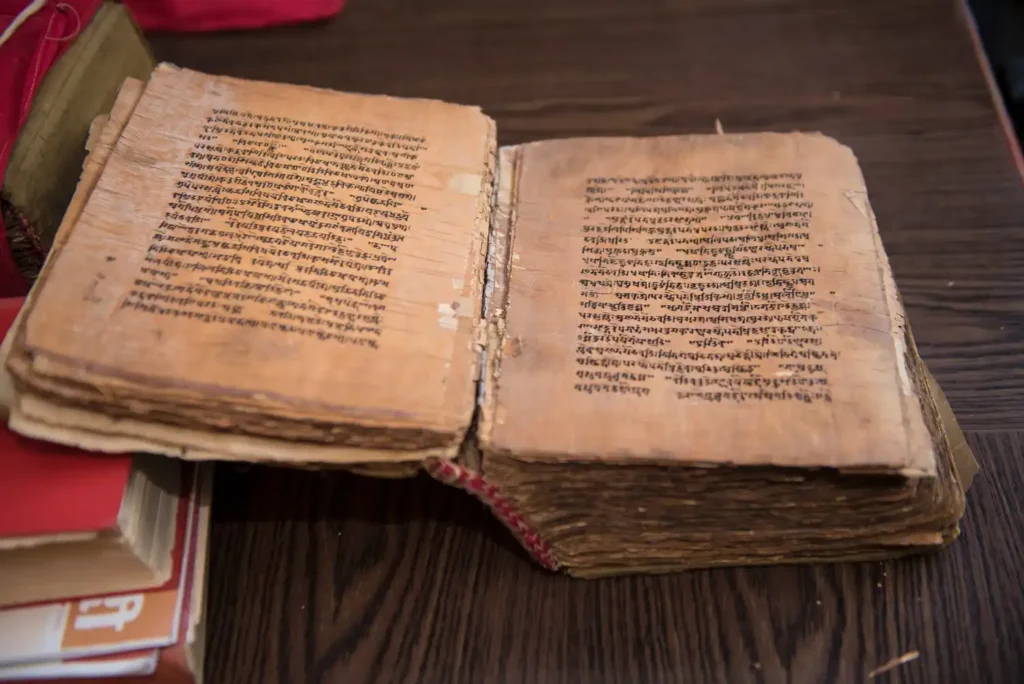
Maharśi Vālmīki is known mainly for writing the epic Rāmāyaṇa but very few know that he also wrote another equally profound book called Uttara Rāmāyaṇa, Mahārāmāyaṇa, Ārśa-Rāmāyaṇa, Jñānavāsiṣṭha, Vāsiṣṭharāmāyaṇa, more popularly the Yogavasistha. While Rāmāyaṇa is an evergreen epic that has over 250 versions in different languages, very few have ever heard of the Yogavāsiṣṭha. This is rather unfortunate because the Yogavāsiṣṭha is a philosophical work that covers every aspect of Vaidika philosophy in great depth. Perhaps no other Indian text explores the nature of the human mind as the Yogavasistha does. The two most important questions we can ask concern how to live a good life, and how to attain supreme bliss. One is about ‘ought’ and the other about knowing the ‘self’. In the Rāmāyaṇa, Vālmīki showed how one ought to live a good life, how a king ought to rule, and how a husband, a wife, a brother, and friends ought to be
By learning the ‘ought’s’ of life, we can lead a good life, but this does not make us free of suffering. Even a so-called ‘good’ person maybe plagued with troubles such as anger, envy, jealousy, disease and old age and, ultimately, death. Being a good person is not enough; something more is required. It is to teach this ‘something more’ that Vālmīki wrote the Yogavasistha. In fact, one can properly understand the popular Rāmāyaṇa only by reading the Yogavāsiṣṭha.

The sheer volume of the Yogavāsiṣṭha is enough to deter most readers. It is stated in the Yogavasistha itself that it consists of 32,000 verses divided into six books (Prakaraṇams), namely: the Vairāgya Prakaraṇam, the Mumukṣuvyavahāra Prakaraṇam, the Utpatti Prakaraṇam, the Sthiti Prakaraṇam, the Upaśama Prakaraṇam, the Nirvāṇa Prakaraṇam (Pūrvārdha) and the Nirvāņa Prakaraṇam (Uttarārdha). The number of verses is, in fact, much less. In the introduction to Śrimadvālmīkimahaṛṣṭpraṇītaḥ Yogavāsiṣṭhaḥ, G. V. Tagare puts the number at 23,734 verses.1

The first book, the Vairāgya Prakaraṇam, describes Rāma’s disillusionment with the world. The issue discussed here is whether jñāna (knowledge of the self) or karma (work, effort) is more important in attaining liberation from the misery of the world. The answer is that both are equally important, just as a bird needs both wings to fly.

The Mumukṣuvyavahāra Prakaraṇam is about the qualities of true seekers of liberation and their mental attitude. How the world was created and how it evolved is discussed in the Utpatti Prakaraṇam. The Sthiti Prakaraṇam talks about the preservation of the universe. The world appears to be real, but with the realization of Brahman, the mind is silenced and the world appears as nothing but Brahman. The Upaśama Prakaraṇam is about quieting the mind through proper understanding; the Nirvāņa Prakaraṇam, as the name suggests, is about ultimate freedom. It suggests that knowledge of the self is the best way to break free from the miseries of the world.

It has to be pointed out that the structure of the Yogavasistha is very loose, and apart from the first Prakaraṇam, almost all the major themes are discussed and repeated throughout this mammoth text. As to the division of chapters within each Prakaraṇam, again there seems to be no order. Some chapters have as few as six verses, while others run into hundreds. Often a chapter ends abruptly, and the discussion is continued in the next chapter and the next. Often, while one concept is being discussed, there is a sudden digression and another topic begins. Later the speaker returns to the previous conversation. The Nirvāņa Prakaraṇam is as large as the first five combined. For some reason it is itself divided into two huge sections: the Nirvāņa Prakaraṇam (Pūrvārdha) and the Nirvāņa Prakaraṇam (Uttarārdha).

Interlaced with the dialogue are approximately fifty-five allegorical stories and stories within stories to illustrate the philosophical matters discussed. Here again, certain stories are told in about ten verses, while others, such as that of Cudālā, stretch over several chapters.

All these stories and subplots make it difficult for the modern reader to keep track of who is speaking to whom. For instance, the Yogavasistha begins with a Brahmin named Sutīkṣṇa who goes to the sage Agasti and asks about ways to get out of the misery of the world. To answer his question, Agasti tells him the story of Kāruṇya, a very learned man, well-versed in the scriptures, who has lost interest in life. Noticing this, his father tells him the story of King Ariṣtanemi, who is sent to Vālmīki for the resolution of his sorrows. Vālmīki then tells Ariṣtanemi the story of Rāma’s dialogue with Vasiṣṭha.

Encyclopedic in its scope, the Yogavāsiṣṭha deals with ontology, epistemology, metaphysics, ethics, and psychology. The underlying philosophy of the Yogavasistha is predominantly of Advaita Vedānta. There are several verses of the Yogavāsiṣṭha which are also found in other Upanişads and the Bhagavadgītā. B. L. Atreya made an exhaustive comparative chart, and believed that being a voluminous scripture the Yogavāsiṣṭha may not have been freely available in the days when books were written by hand. Anthologists must have picked up some useful verses from it and used them to create new Upanişads.2

Yogavasistha Core philosophy

Although the Yogavāsiṣṭha is voluminous, its central message can be expressed in a few statements: Nothing exists except absolute consciousness (also called universal consciousness or Brahman), and the world is the imagination of this universal consciousness. The universal consciousness is absolute and perfect. All change happens in the phenomenal world, (which has no independent existence, as it is just an imagination of absolute consciousness). All the beings of the world are no different from the universal consciousness, as they emerged out of it. All the misery that is experienced by individual beings happens because they mistakenly identify themselves with their body and forget that they are essentially the same as the universal consciousness, Brahman. Since misery arises out of ignorance of the self, it ends with knowledge of the self. Ajātivāda says that the world was never created (aja) as it is imaginary or illusory. What can we say about the origin of a thing that is imaginary? It was there always as imagination of absolute Brahman, hence we cannot ask the question when it was born. Only Brahman truly exists, and Brahman or the absolute is non-dual.

The scriptures are words of the enlightened to awaken those who are taking their dream to be real. Once we wake from the dream, we realize that nothing has to be gained because nothing was ever lost. No one has to be liberated because there was no bondage in the first place as the absolute can never be bound. 

न बन्धोऽस्ति न मोक्षोऽस्ति देहिनः परमार्थतः।
मिथ्येयमिन्द्रजालश्रि: संसारपरिवर्तिनी।।

Ultimately, there is neither bondage nor liberation for the self;
Illusion alone keeps all trapped in the vicious cycle of the world.3

All that ends after knowledge dawns is the illusory world, not the eternally blissful self. Liberation and bliss are our intrinsic nature (svabhāva), and svabhāva means that which can never be taken away from us. The truth, therefore, is that the mind has no existence other than in the imagination of absolute. That absolute is not nothingness; it is complete and encompasses all, and whatever emerges from it is also absolute. 

पूर्णात्पूर्ण विसरति पूर्णे पूर्णे विराजते। 
पूर्णमेवोदितं पूर्णे पूर्णमेव व्यवस्थितम्।।

From the whole emerges the whole, and the whole is situated in the whole;
Thus, whatever is there in the whole exists in its wholeness.4
Vasişţha relies solely on reason. He does not advocate any kind of blind faith, worship, or rituals. It is for this reason the Yogavasistha could have a tremendous appeal to any modern thinking person, provided they have the patience to listen to the full argument. No other Indian text analyses the human condition as thoroughly as the Yogavāsiṣṭha does. Vasiṣṭha himself says: 

यदिहास्ति तदन्यत्र यन्नेहास्ति न तत् क्वचित्।
इमं समस्तविज्ञानशास्त्रकोशं विदुर्बुधाः।।

What is in it is nowhere else, what is not in it is not elsewhere;

Hence the learned have called it a repository of scriptures.5
People normally think that those who seek self-liberation ought to withdraw from active life and lead the life of a hermit − praying, meditating, and performing rituals. Vedānta does not advocate this type of life. It says that you ought to go on doing whatever you are supposed to, but remember all the time that you are not the doer. Do everything with a sense of detachment and be unaffected by whatever is happening around you, just as a lotus grows in a pond without getting wet.

The Yogavasistha does not advocate worship of any kind, rituals, neither ablutions nor prayer to a deity, not even meditative techniques. It, however, seriously discourages escapism and laziness, and strongly advocates human effort. 

स्वपौरुषप्रयत्नेन  विवेकेन  विकासिना।
स देवो ज्ञायते राम न तप:सनानकर्मभि:।।

Through effort and maturity alone is the self known, Rāma,
Not through penance, holy bath, and other such actions.6 

Rāma’s dialogue with Vasiṣṭha, after which Rāma becomes free of the miseries of the world. The book which narrates this dialogue is called the Yogavāsiṣṭha. It is said that one can become free of worldly miseries merely by reading the Yogavasistha.

After Vālmīki wrote the epic Rāmāyaṇa, called in full, Pūrva Rāmāyaṇa, he was approached by Brahmā, the creator of the world, to write a book that would free humans of worldly misery and make them eternally blissful. Thus was born the scripture known variously as Uttara Rāmāyaṇa, Mahārāmāyaṇa, Ārśa-Rāmāyaṇa, Jñānavāsişţha, Vasiṣṭharāmāyaṇa, more popularly called the Yogavāsiṣṭha.

Liberation for all

One striking feature of the Yogavāsiṣṭha is that its vision is secular. Furthermore, it does not believe in gender, race or caste discrimination. All that is required on the part of a seeker is to be a sincere and determined disciple. In fact, the main character of one of its longest stories is a queen named Cudālā. She not only acquires self-knowledge but also teaches her husband the means of acquiring it. The Yogavāsiṣṭha goes even further by showing that one need not be of high birth to attain self-knowledge: anyone can have it. It names people from lower castes and wild tribes, and gives instances where animals, too, become liberated. Even Śeşanāga, the deadly snake, is liberated, as is Kākabhuşuņda, the crow. This might sound far fetched, but the point being made here is that anyone can become blissful if they really wish to.

1. Pansikar, Vasudeva Laxmana Sharma (Ed.), Srimadvālmīkimahāŗşpraņītaĥ Yogavāsiṣṭhaḥ Vol I, Motilal Banarsidass Publishers, Delhi, p VII 
2. Atreya B. L., Yogavāsiṣṭha aur Uske Sidhdhant, Shri Krishna Janamsthan Seva Sansthan, Mathura 1986, p4; for comparative charts see pages
45-59, 67-69 of the same book. 
3. Yogavāsiṣṭha V:18:27
4. Yogavāsiṣṭha VIB:53:20
5. Yogavāsiṣṭha III:8:12
6. Yogavāsiṣṭha III:6:9 

A Metaphorical Exploration into the Ideas on Inheritance and Progress

When we casually attempt to define modernity, words associated with temporality often find their place. For instance, ‘progress’, ‘change’, ‘movement’, ‘transformation’, etc, are some of the words often associated with it. These words are highly future-oriented, which is to say that there is an underlying implication involved stating any ‘change’, ‘movement’, ‘transformation’ or such temporal shifts were necessary for anything good to happen. This way, modernity tends to be the standpoint(s) of an assumed present-future against an assumed past to produce ‘new’ and the ‘old’, while qualifying the former and disqualifying the latter. When we speak about time, it is about such orderings of past, present and future. Time perception among cultures and societies varies according to their narration about each of these temporal registers. In other words, each culture will have their own ways of looking at the past and future. These different ways would in turn influence how these cultures inherit a tradition and how they think about progress, change, catastrophe and deterioration.

As humanity goes through the tunnel of modernity, historicism and progressivism became the dominant way to approach our past and think about the future. In modernity, we are to experience time in terms of change and rupture over the flow of continuity. This is perhaps best expressed in our historical discourses, which bring in temporal registers like ancient, medieval and modern that tends to emphasize the break of ‘periods’ over continuity. History is usually regarded as the study of the past and many historians assume that they work on the past. But the way we perceive the past is dependent on how we look at the future. This is to say that even the future that we are referring to is ‘historical’1. Such a mode of inquiry about the past must be located as a construct of specific culture. Therefore, there is a need to locate the modern time regime as a construction of specific culture, provincializing it into a historical development of a specific period and space that we today call as ‘West’, rather than unmindfully considering it as a ‘universal’ ‘scientific’ paradigm.

To articulate the dominance and implications of the modern perception of time in our thinking is a very delicate and complex endeavor. With an intention to simplify this discourse, in this article, I have taken the aid of a popular metaphor or figure of thought in English to unpack the modern temporal regime, and how the ‘ancient’ (Hindu) thinking would look at the same.

‘Standing on the Shoulders of Giants’: A ‘Modern’ reflection of the Metaphor 

The age-old metaphor, ‘We stand on the shoulders of giants’ is a very prominent expression to show respect to the elders (past). To give a popular instance, Sir Isaac Newton in a letter to his friend writes, “If I have seen further, it is only because I have stood on the shoulders of giants.”2. One of the earliest known attributions to this metaphor is given to a 12th-century neoplatonist philosopher, Bernard of Chartres. Arguably, we see a transition in the usage of this metaphor from traditional (pre-Christian) to its modern form. Knowing this transition helps us to understand how the idea of ‘progress’ was viewed differently in ancient and secular modern (Christian?) ways of thinking.

Bishop of Chartres – John of Salisbury interprets the metaphor as, “We (the moderns) see more and further than our forebears did, not because we have better eyes or because we’re taller, but because we dwarfs are sitting on the shoulders of giants (the ancients).”3 In short, the interpretation tries to convey that we see more not because we are great but because our ancestors were giants. However, the underlying inference is that the dwarfs’ vision (modern) is much more far-reaching than that of the historical giants. In spite of their physical limitations, the dwarfs benefit from additional historical support from the past to view more of the present.

The famous depiction of this metaphor appears to be at Chartres Cathedral, where the four apostles of the New Testament are standing on the shoulders of four prophets of the Old Testament looking up at the Messiah.

These images suggest to  us how the people of the New Testament (Christians) who are modern to the people of the Old Testament (Jews) relate to each other. In this framework, the Old Testament forms the ground basis for a new world to emerge, which is also detached from its foundations. The New Testament surpasses the other and grows beyond it. It is worth noting that the Old Testament isn’t destroyed or rejected completely, but it is kept as having a pre-historic value, a necessary foundational step taken for the fulfillment of time. The Old Testament should stand as a monument for the New Testament to surpass, compare and contrast itself with. In other words, the register of ‘Old’ is maintained or preserved so that the ‘New’ could emerge and compare itself with, for its own self-positioning, and to measure how far it has seen better than the old one. The idea of the museum in modernity serves the same purpose of preserving what was destroyed. In the words of Bruno Latour, “Moderns are cut off from a past that is maintained in a state of artificial survival due only to historicism”.4

‘Standing on the Shoulders of Giants’: A Hindu (‘ancient?’) reflection of the Metaphor

From an ‘ancient’ perspective, this metaphor aptly reveres the past, for it is the foundation of the tradition (just as Hindus may regard Vyāsa and Śaṅkarācarya as being the giants of Hinduism). It is not in the sense that the dwarfs supersede and get a better vision than their ancestor giants because of an added linear, chronological support. The Hindu wisdom does not allow room for such an interpretation, arguably because the axiom of Time’s arrow prevalent both in Biblical themes and Modernity makes no sense to the Hindu view on reality. The modern interpretation of the metaphor suggests discovering a new truth by building or adding on previous discoveries or testaments. On the other hand, the Hindu view on inheritance and civilizational progress would have more emphasis on constant reflection of the existing knowledge over endless ‘additions’. This thought would require a bit more explanation to gain clarity.

For the Hindus, relearning the inherited knowledge doesn’t mean mere repetition of the same content. Rather, it is a new learning and application of knowledge to contemporary changes. While the traditional text inherited from the past stands as an everlasting normative reference point, each generation will have to locate it into their own actional framework and experience it, as these texts are designed in a way that they are timeless and could be applied to all relatable contexts.5 In simple words, it constantly trains us to become ‘contemporary’ rather than ‘modern’ or ‘ancient’.6

It could be misinterpreted that in the Hindu knowledge traditions, it was not encouraged to ask questions, critique, or disallow any ‘additions’. In other words, it is often classified as the Western notion of progress as ‘optimistic’ and the Indian notion of time as ‘pessimistic’, which does not plan for the future at all. But such an allegation can only emerge from the standpoint or assumption of a culture that completely marches ahead for ‘progress’, that cannot perceive change and continuity to be in harmony with each other. From an Indic way of thinking, it should not sound difficult to think about questioning the ancestors and yet revering them, as questioning itself is a part of the Hermeneutics of Śraddhā.7 In such a scenario, progress does not appear as a march towards a proposed utopian future; rather, progress seems to be about duties and responsibilities for contemporary times, which an individual and society accept by reflecting, contextualizing or expanding on what has been inherited. It is necessary to have a realistic understanding of the potential consequences of one’s present actions on the future in order to act responsibly. Thus the Karma Yoga lesson tries to tell us that fulfillment of action (time) is not dependent on the result (future event); on the other hand, its fulfillment lies in performing the action itself, by being in the present, detached from the results or future.8 It acknowledges the uncertain nature of the future, which cannot be determined before performing the action. This notion emphasizes the present actions instead of taking bearing from the future (results). This way, it stands quite different from the teleological narrative embedded in early modernity, which constantly marches towards ‘utopian ends’ (results), expecting an ideal future that is different from the present.9

Henceforth, the Hindu Hermeneutics of Śraddhā provides scope for inheriting from the past, allowing us to experience it in the present through experimenting, relating, contextualizing, regionalization, questioning and responding systematically. This riddle to re-learn that each individual and generation faces is what makes the tradition alive. From this standpoint, Vyāsa or Āḍi Śaṅkarācārya appear as ‘Giants’ not because they are foundational and took the ‘first step’ so that the succeeding masters could surpass them. The Hebrew Bible of the Jews, on the other hand, provides scope for an ‘addition’, as it takes its bearing from the future, anticipating the coming of the Messiah, which enables the ‘New’ to emerge from the foundation of an ‘Old’ in a linear, chronological ordering. From this standpoint, the ‘Giants’ are the ones who are to be surpassed because they are outdated but could be respected because they are ‘foundational’ or took the necessary first step.

As mentioned earlier, the different view of looking at the ‘Giants’ is related to a cultural difference between Hinduism and Semitic Religions/Secular Modernity. Being that said, though we may be able to interpret the metaphor and the ‘Giants’ (Past) in a Hindu way as mentioned above, the usage of the metaphor may not be acceptable for our cultural consciousness. Even with a Hindu understanding of what it means to be ‘Standing on the shoulders of Giants’, we may not prefer this metaphor to describe our reverence towards our Ṛṣis just because they don’t carry our cultural experience.

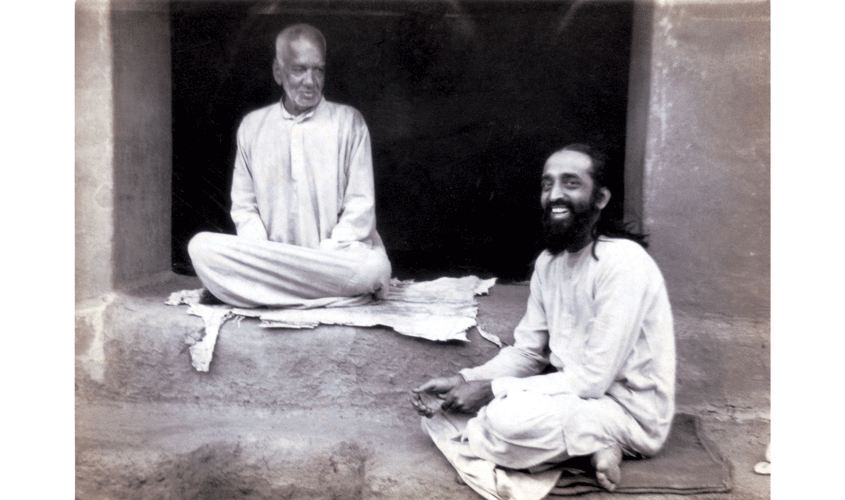
Though the metaphor ‘Standing on the shoulders of Giants’ could be interpreted positively by the Hindus (unlike the moderns), ‘Sitting at the feet of Giants’ remains a popular imagery of the Hindu traditions. This practical bodily action could better metaphorically convey the Hindu mode of reverence than the former. Here is an image of Swāmi Chinmayānanda, who sits at the feet of his Guru, Swāmi Tapovan Mahārāj, who in turn is sitting at an elevated position.

This gesture conveys that the disciple is receiving the knowledge from his Guru, sitting on a ground which indicates a locale which is contemporary. Whereas the Guru speaks from the past which is elevated, as past is our normative reference point from which we inherit knowledge and experience it by contextualizing from the ground or the present.

Om Tat Sat

References:

 ‘The past has had different possible futures’ is one of the key arguments that came about from Reinhart Koselleck’s work on history, in which he critiques the assumption that historians work on the past. Reinhart Koselleck, Future’s Past: On the Semantics of Historical Time, trans. Keith Tribe (New York: Columbia University Press, 2004).

See Robert King Merton, On the shoulders of Giants: A shandean Postscript, New York: Harcourt Brace Jovanovich, 1985,p.1.

John of Salisbury, Metalogicon, Book III, Chapter 4. Cfr. Troyan, Scott D., Medieval Rhetoric: A Casebook, London, Routledge, 2004, p. 10.

4 Bruno Latour, We Have Never Been ModernHarvard University Press, 2012, p.133. 

As an example, The major interpretation of the Bhagavad Gītā that came about during the freedom struggle by Gandhi, Tilak contained an expansion from the traditional Gītā, a cognitive/evaluative frame to their actional frame of freedom struggle, for a direct experience of the Gītā. See for instance, Vivek Dhareshwar, ‘Framing the Predicament of Indian Thought: Gandhi, the Gita, and Ethical Action’, An International Journal of the Philosophical Traditions of the East, 22:3, 257-274.

6 In the words of Latour, ‘Modernity’ is that which disables our ability to be ‘Contemporary’. See in, Latour, B. (2017). Anthropology at the Time of the Anthropocene: A Personal View of What Is to Be Studied. In: Brightman, M., Lewis, J. (eds) The Anthropology of Sustainability. Palgrave Studies in Anthropology of Sustainability. Palgrave Macmillan, New York. https://doi.org/10.1057/978-1-137-56636-2_2

In fact, it is through constant questioning and argumentation that the Indian Knowledge Traditions have expanded themselves. See, Amartya Sen, The Argumentative Indian: Writings on Indian History, Culture and Identity. United Kingdom: Penguin Adult, 2006.

8 The verse; ‘Karmaṇyevādhikāraste mā phaleṣu kadācana, mā karmaphalaheturbhūrmā te saṅgo’ stvakarmaṇi’ Bhagavad Gītā 2.47. “Thy right is to work only [in the ‘present’], but never to its fruits [results in ‘future’]; let not the fruit of action be thy motive, nor let thy attachment be to inaction.” (Translation: Swāmi Chinmayānanda)

9  Peter Sloterdijk, Infinite Mobilization: Towards a Critique of Political Kinetics, trans, Sandra Berjan, Cambridge: Polity Press, 2020, pp.1-3.

Better Understanding of Hinduism Requires a Multi-Pronged Approach

There is no single solution to the challenge of cultivating better narratives, methods, and paradigms to  improve and expand the understanding of Hinduism and Hindus.

“Do you speak Hindu?” 
“Are you Shia or Sunni Hindu?” 
“What caste are you?” 

These questions, unintentionally frustrating as they might be, are a feature of being Hindu in America. They are also the reason why my answer to the importance for Hindu Studies in academic environments is an emphatic yes.

In spite of being practitioners of the third largest religion and one of the oldest surviving family of philosophies and traditions, a survey by Pew Research Institute found that Americans as a whole know little about Hinduism, and those who know something or think they know something, have ambivalent impressions of Hindu Americans. At the same time, the popularity of Hindu practices like yoga and ayurveda continue to skyrocket, but are intentionally delinked from Hinduism. And scientific inquiry in quantum physics or cognitive psychology are increasingly converging with Vedantic understandings of reality and Consciousness, yet acknowledgement of Hinduism is all too often missing.

There are some 3.5 million Hindus living in America, several million across other diasporas, and over a billion  in the Indian subcontinent. We live in diverse and pluralistic societies across the globe. The world is  becoming smaller as a result of mass communication and globalization. Considering all of these realities, it becomes imperative that who we are as a people and how we engage with the world is understood. 

One way to do that is through the academic study of Hinduism. Unfortunately, the current state of Hindu  studies, built as it is on the foundation of Christian frameworks about religion and history, rather than provide accurate and nuanced understandings of Hindu history, teachings, and traditions, perpetuate outright  fallacies and harmful stereotypes. 

There is no single solution to the challenge of cultivating better narratives, methods, and paradigms to  improve and expand the understanding of Hinduism and Hindus. But here are a few that I believe are  feasible: 

1. Support through academic grants scholars committed to the study of Hinduism as a lived tradition who:

  • highlight emic understandings; 
  • explore lesser known aspects of Hindu history, philosophy or traditions; 
  • expose biases in dominant paradigms and methods;
  • develop new paradigms and methods to study Hinduism; or
  • engage in the comparative study of religion. Given that we do not want, appreciate, nor find constructive oversimplifications or broad brushstrokes about the Hindu traditions, Hindus must gain more nuanced understandings of Christianity, Islam, Judaism, etc. which can pave way  for deeper understandings of Hinduism through thoughtful comparative studies.

2. Call out bias and advocate for higher standards in the various academies engaged in the study of religion, history, etc. For example, see my call to the American Academy of Religions to adopt a code of academic integrity: Academic Integrity: It’s What’s Missing at the AAR

3. Build bridges between academics, activists, and communities with other previously colonized civilizations or countries working through their own decolonizing processes to exchange ideas, share best practices, do comparative work, and cooperate constructively.

4. Encourage more second and third generation Hindu Americans to pursue the academic study of not only religion, but history and other humanities and social sciences. This cannot be done in a vacuum. It will require investment in our own svadhyaya, sadhana, and positive identity building as contributing members of our respective families, communities, and sanghas, sampradayas, or mathas.

5. Encourage more second and third generation Hindu Americans to pursue the academic study of not only religion, but history and other humanities and social sciences. This cannot be done in a vacuum. It will require investment in our own svadhyaya, sadhana, and positive identity building as  contributing members of our respective families, communities, and sanghas, sampradayas, or  mathas.

References

1.    “What Americans Know About Religion.” Pew Research Center, Washington, D.C. (July 23, 2019)
2.    Shukla, Suhag A. Web log. Academic Integrity: It’s What’s Missing at the AAR (blog).

This blog is an adaptation of a term paper submitted for the Fall 2020 quarter of  Orientation to Hindu Studies (HSF 5000)

HUA at World Hindu Congress, Bangkok

The World Hindu Congress in Bangkok was a convergence of cultural richness and a shared commitment to the progress of Hindu Civilization, and HUA stood out as a sponsor, bringing diverse perspectives, academic excellence, and a vibrant showcase of their educational offerings.

“Hindu University of America’s Dynamic Presence and Impactful Participation at the World Hindu Congress in Bangkok”

Empowering Minds, Enriching Discourse, and Leading the Way Forward

The recently concluded World Hindu Congress (WHC) in Bangkok transcended being a mere gathering—it became a convergence of cultural richness, wisdom, and a shared commitment to progress. Standing out among the contributors to this global symposium was the Hindu University of America (HUA), bringing a kaleidoscope of perspectives, academic prowess, and a vibrant showcase of their educational offerings.

About the World Hindu Congress:

The World Hindu Congress in Bangkok served as a global nexus, uniting Hindu thought leaders across seven pivotal tracks. These tracks, ranging from the World Hindu Economic Forum to the Hindu Women Conference, collectively addressed diverse facets of the Hindu diaspora. The congress provided a platform for collaborative discourse, fostering discussions on economic empowerment, education, media influence, political engagement, women’s issues, youth empowerment, and organizational collaboration. It encapsulated the essence of collective thinking and valiant action within the global Hindu community.

Sponsorship and Booth Showcase:

HUA’s enthusiastic participation was evident from the start, with the university proudly listed among the sponsors of the WHC. Their commitment to the cause was further showcased at their booth in the Exhibition Hall—an interactive space attracting attendees eager to explore the educational offerings and engage with the representatives.

Distinguished Presence:

The WHC was graced by almost 10 Board Members, Advisors, and Overseers from Hindu University of America. Their active involvement in various sessions and discussions added depth to the academic discourse, providing unique insights into the challenges and opportunities facing Hindu education globally.

Faculty and Student Engagement:

The academic heartbeat of HUA echoed through the participation of five esteemed faculty members. Their presentations, discussions, and interactions highlighted the institution’s commitment to education and knowledge dissemination. From exploring ancient Hindu scriptures to delving into contemporary issues, HUA’s faculty brought a diverse range of topics to the forefront.

Several students from HUA added a dynamic and energetic dimension to the congress. Engaging in discussions, networking, and contributing to various tracks, the students demonstrated the next generation’s enthusiasm for preserving and advancing Hindu heritage.

Global Reach and Impact:

HUA’s active participation in the WHC showcased not just their global reach but also their commitment to making a positive impact. By participating in tracks like the World Hindu Economic Forum, Hindu Women Conference, and Hindu Political Conference, HUA demonstrated a holistic approach to education—one that extends beyond the classroom to address real-world challenges.

Conclusion:

The World Hindu Congress was a celebration of diversity, unity, and the collective strength of the global Hindu community. Hindu University of America, with its sponsorship, booth showcase, and active participation, emerged as a beacon of academic excellence and a driving force behind the congress’s success. As we reflect on the WHC, it’s evident that institutions like HUA play a pivotal role in shaping the narrative of Hinduism and fostering a new generation of leaders committed to preserving and advancing our rich heritage.

In the spirit of the congress’s theme, “Think Collectively, Act Valiantly,” Hindu University of America exemplified the power of collective action in advancing the cause of Hindu education on the global stage. The echoes of their contributions will undoubtedly resonate far beyond the conference halls, leaving a lasting impact on the future of Hindu academia.

HUA@Ayurveda Beyond Wellness Conference, Orlando

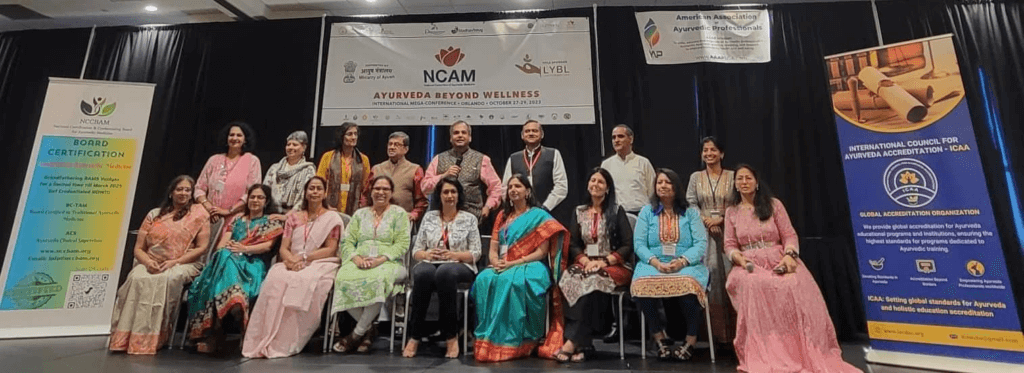
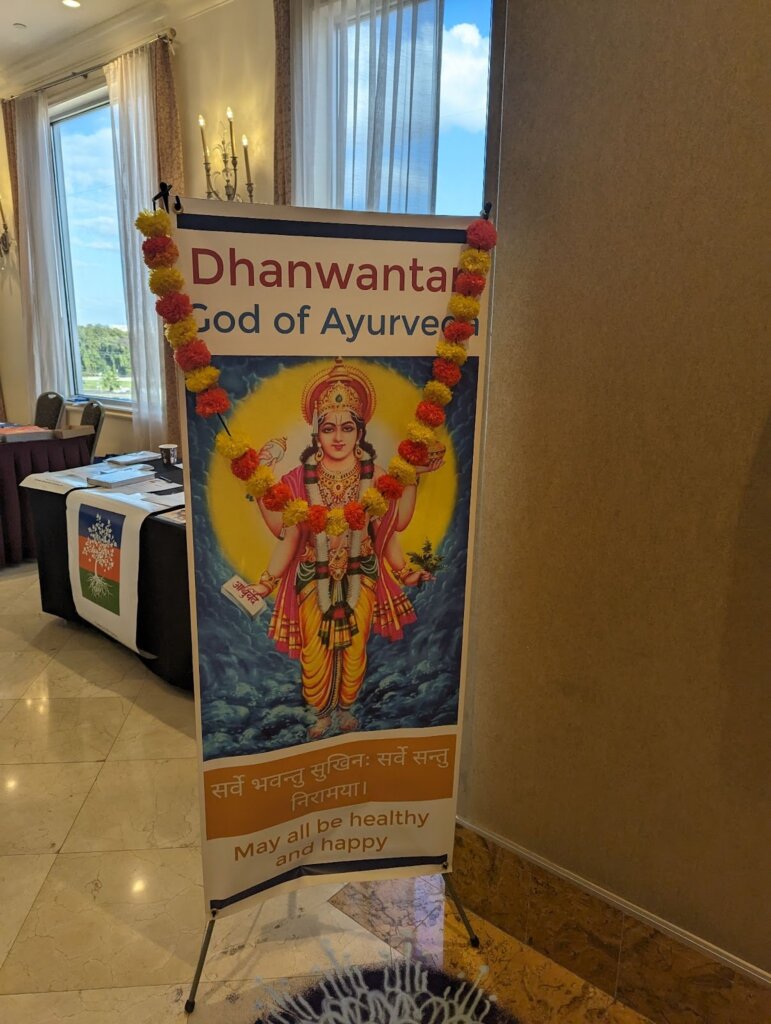
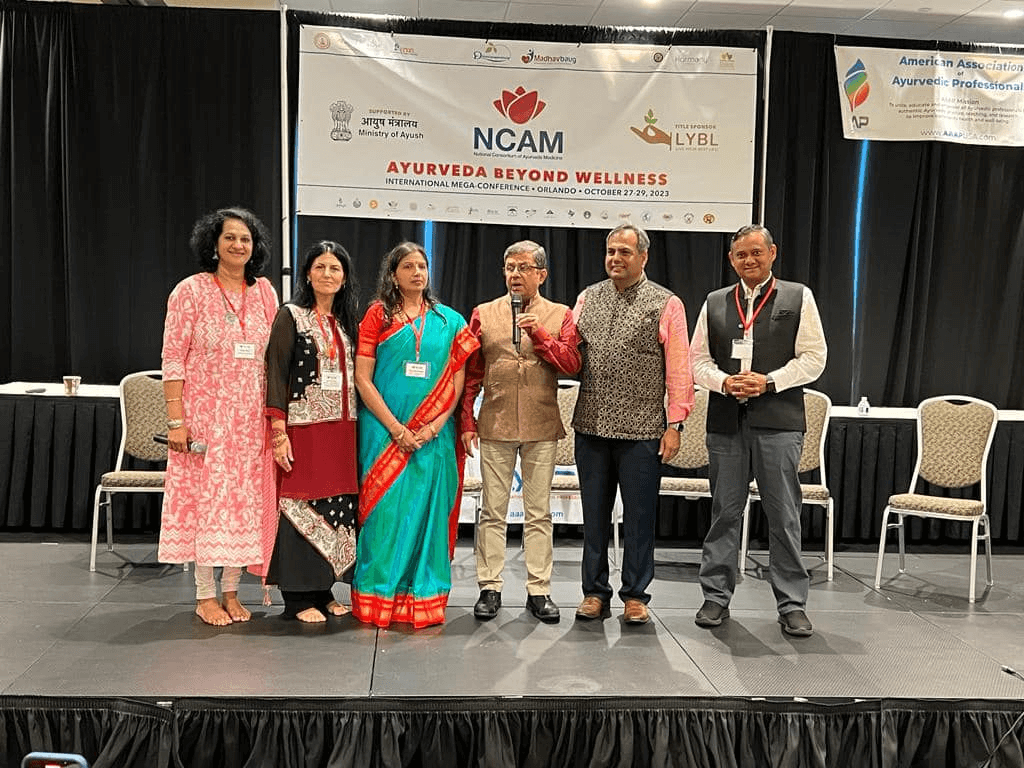
Hindu University of America was the proud Silver sponsor of the Ayurveda Beyond Wellness conference held in Orlando and the gracious host of a memorable pre-conference dinner emphasizing its commitment to promoting the authentic essence of Ayurveda.

“Harmony of Wisdom and Wellness: Hindu University of America’s Impactful Role in Ayurveda Beyond Wellness Conference”

In the luminous landscape of Ayurvedic wisdom, the Ayurveda Beyond Wellness conference, held in Orlando from October 26 to 29, 2023, became a focal point for luminaries, experts, and enthusiasts. At the heart of this transformative gathering was the Hindu University of America (HUA), standing proudly as a Silver Sponsor and the gracious host of a memorable pre-conference dinner. This blog delves into the significant role played by HUA, showcasing not only its commitment to promoting the authentic essence of Ayurveda but also its dedication to fostering a community dedicated to holistic well-being.

HUA as a Silver Sponsor:

The National Consortium of Ayurveda Medicine (NCAM) orchestrated the Ayurveda Beyond Wellness conference, bringing together global stakeholders in Orlando. The event, held from October 26 to 29, 2023, featured pre-conference sessions, panel discussions, and experiential sessions led by luminaries like Sadhguru and David Frawley. With a diverse range of topics spanning health, education, entrepreneurship, and scientific integration, NCAM’s conference marked a pivotal initiative to advance Ayurveda in the United States.

HUA’s role as a Silver Sponsor reflected its commitment to the profound wisdom encapsulated within Ayurveda. By contributing valuable insights and financial support, the university demonstrated a shared vision with the conference organizers, advancing the cause of Ayurveda on a national and global scale. This sponsorship underscored HUA’s recognition of Ayurveda as an integral part of Vedic teachings, aligning seamlessly with its mission of preserving and disseminating Vedic knowledge.

Pre-conference Dinner Hosted by HUA:

HUA’s engagement extended beyond sponsorship, as the university took the initiative to host a pre-conference dinner, creating a warm and welcoming atmosphere for participants. This dinner served as a platform for networking, fostering connections, and initiating conversations that set the tone for the collaborative spirit of the upcoming conference. Hosted at the administrative offices of HUA, the dinner offered a seamless blend of cultural richness and intellectual exchange.

Key Highlights of the Pre-conference Event:

  1. Welcoming Address by Dr. Mahadevan Seetharaman
  2. Introductory Remarks by Shri Braham R. Aggarwal
  3. Keynote by Shri Kalyan Viswanathan, President of HUA
  4. Sitar Performance by Vaidya Kannada Narahari
  5. Networking, Interactions with Ayurveda Community, and Dinner

Dr. Mahadevan Seetharaman, a conference organizer and Faculty at HUA, extended a warm welcome to all attendees, emphasizing the university’s dedication to promoting Ayurveda and Vedic knowledge. Sri Braham R. Aggarwal, Chairman of Park Square Homes, provided visionary insights and set the tone for a conference that blended business acumen with a profound dedication to well-rounded growth. His welcome highlighted HUA’s benefactors’ commitment to holistic well-being, reflecting in philanthropy, education advocacy, and spiritual initiatives.

Shri Kalyan Viswanathan, President of HUA, delivered a keynote address that drew on his extensive association with Pujya Swami Dayananda Saraswati and his deep study of Hinduism, particularly from an Advaita Vedānta perspective. Emphasizing HUA’s commitment to supporting NCAM and Ayurveda initiatives in the United States, Viswanathan set the stage for harmonious integration of traditional wisdom and academic excellence in the pursuit of Ayurveda’s expansion.

Dr. Kannada Narahari, an Ayurveda doctor and accomplished sitar player, delivered a mesmerizing solo sitar performance. His musical prowess resonated, showcasing the integration of Ayurveda, literature, and music in a soulful presentation.

Mitra! Ask me anything!