






Transforming Karma Into Yoga

For the vast majority of people on the planet, the only conceivable human pursuits and actions (karma) possible are limited to the realms of Security and Pleasure (artha and kāma). But within those realms there are infinite possibilities—many branches and numerous branches too (bahu-śākhā hyanantāś ca)[1]. Our innumerable desires (kāma), centered on our likes and dislikes, (rāga and dveṣa) lead to effort and action (karma), which yield results (phalam), which are either in keeping with our expectations or not—and lead to pleasure and pain, (sukha and duḥkha), fear and anger (Bhaya and krodha). And so, we go around and round, bound by karma life after life (karmabandha)[2]. For many, attaining a certain measure of security in life is, in and of itself, a constant and never-ending struggle, almost a daily battle. This is borne out by the extraordinary inequality in wealth and income distribution in the world. For those who have attained a measure of security, all there is left to do seems to be the pursuit of never-ending varieties of pleasure, enjoyment, and power (bhogaiśwarya-gatiṁ prati)[3] until they are no longer able to do so. Some may hope to attain heaven after death (svargaparāḥ)[4] at least in a western context, while in a Hindu context, there is one more thing to aspire for i.e. a better birth in one’s next life (janma karmaphala pradām)[5]. In any case, almost universally, our inner disposition is inextricably mixed up with our outer circumstance—acquiring and protecting (yoga kṣemaḥ)[6] the money in the bank, how our investments are doing, the well-being of our families and friends, the association and the esteem of our social peers, our titles and accomplishments and so on.

Until one awakens to the possibility of mokṣa.

In the Bhagavad Gītā, Krishna holds out the possibility of a radical dissociation of one’s inner disposition from one’s outward circumstances, exemplified by the ideal of the sthita-prajña[7] whose abiding peace is centered on the Self alone (ātmanyevātmanā tuṣhṭaḥ)[8] and is unconcerned with the anxieties of acquiring and protecting (niryoga-kṣema ātmavān)[9] material things. Without this awakening of a desire for mokṣa, and thereafter jñānam, neither jñānayoga nor karmayoga, as two lifestyles (dvividhā niṣhṭhā)[10] have any relevance. Sanyāsa as a lifestyle, actively and deliberately embraces tremendous physical and financial insecurity i.e., no income, no medical insurance, no savings, and no retirement plan—at least that is how it ought to be—–notwithstanding the many sanyāsins, who seem to continue to have worldly business interests. Yet, in the midst of this physical and financial insecurity and uncertainty, the (vidvatsanyāsin abides in a settled and almost unperturbed inner security, or that is how he or she ought to be. Indeed, there are very few people who can attain this equipoise in the face of the crushing burden of economic insecurity, while still pursuing mokṣa and jñāna (vividiṣa sanyāsa).

Even though we may develop an awareness of all of these attachments being temporary and time bound, (anityam), it is not easy to walk away from it all—giving up the security and comfort of a life as we know it, in favor of a life that is entirely unknown and uncertain. The transition from gṛhastha to sanyāsa is not easy to make. In Hindu thought, vānaprasthāśrama is structured as a stage in life which is transitional, when one gradually extricates oneself from worldly interests. The vana (Forest) symbolizes a retreating away from the hustle and bustle of the everyday kurukṣetra that each of us find ourselves in. And karmayoga is the critical shift in attitude[11] that enables this transition and can even constitute a committed lifestyle as an alternative to sanyāsa. Making and viewing pleasure and pain, gain and loss, victory and defeat as essentially the same (sukha-duḥkhelābhālābhaujayājayau, same kṛitvā)[12], prepare for battle (yuddhāya yujyasva)[13] says Krishna—once again articulating a paradox. How does one engage deeply with the battles of the world, if at the same time, one does not care in the least for how they turn out?

The critical ingredient that transforms karma into karmayoga is the discernment of mokṣa as the singular and final commitment in life, to the exclusion of all other interests. There is a certain clarity (niścaya) that has arisen in the mind, regarding the transitory nature of existence in the world, (nitya– anitya vastu viveka) that is no longer easily shaken by the entanglements with the world (nistrai-guṇyo bhava)[14] where innumerable outcomes, experiences, and desires can easily carry one’s buddhi away (avyavasāyinām)[15]. The evenness of mind, (samatva)[16] that is at the heart of karmayoga[17], in the face of success and failure, (jayājayou)[18] pleasure and pain (sukhaduḥkha)[19], profit and loss (lābhālābhau)[20]—which are of a material nature (prakṛti– trai-guṇya)[21] arises from three sources: first, the practical recognition that as a human being, we have jurisdiction (choice, authority, power – adhikāra)[22] over the realm of action alone, (karmahetu)[23] but not over the realm of results of those actions (karmaphala hetu)[24]; second, the assimilated understanding that the results of our actions are governed by laws of this world, both seen and unseen, not within our own jurisdiction but of that of Īśvara; and third, in any case, we are no longer yearning for results within the material sphere (trai-guṇya), and that our commitment to mokṣa has assumed a singular and unshakable priority in our lives i.e., we wish to know (jñāna) and be more fully that which we have come to know—an ātmavān.[25] Without the discernment of mokṣa as our ultimate purpose of human existence, and its attendant end to all other forms of seeking[26], one is still embroiled in worldly life—pursuing various ends and enjoining Īśvara to actively join in the task of accomplishing the results that we are aspiring for, which is the condition of most human life. Our karma and our attachments to the karmaphalam may be tempered by prasāda buddhi[27] but is yet to fully transform into a karmayoga.

[1] Bhagavad Gita, Chapter 2, Verse 41, Gita Home Study Program, Page 256
[2] Bhagavad Gita, Chapter 2, Verse 39, Gita Home Study Program, Page 249
[3] Bhagavad Gita, Chapter 2, Verse 43, Gita Home Study Program, Page 262
[4] Ibid.
[5] Ibid.
[6] Bhagavad Gita, Chapter 2, Verse 45, Gita Home Study Program, Page 266
[7] Bhagavad Gita, Chapter 2, Verse 55, Gita Home Study Program, Page 310
[8] Bhagavad Gita, Chapter 2, Verse 55, Gita Home Study Program, Page 310
[9] Bhagavad Gita, Chapter 2, Verse 45, Gita Home Study Program, Page 266
[10] Bhagavad Gita, Chapter 3, Verse 3, Gita Home Study Program, Page 373
[11] Bhagavad Gita, Gita Home Study Program, Page 254
[12] Bhagavad Gita, Chapter 2, Verse 38, Gita Home Study Program, Page 248
[13] Ibid.
[14] Bhagavad Gita, Chapter 2, Verse 45, Gita Home Study Program, Page 266
[15] Bhagavad Gita, Chapter 2, Verse 41, Gita Home Study Program, Page 256
[16] Bhagavad Gita, Chapter 3, Verse 48, Gita Home Study Program, Page 282
[17] Ibid.
[18] Bhagavad Gita, Chapter 2, Verse 38, Gita Home Study Program, Page 248
[19] Ibid.
[20] Ibid.
[21] Bhagavad Gita, Chapter 2, Verse 45, Gita Home Study Program, Page 266
[22] Bhagavad Gita, Chapter 2, Verse 47, Gita Home Study Program, Page 270
[23] Ibid.
[24] Ibid.
[25] Bhagavad Gita, Chapter 2, Verse 45, Gita Home Study Program, Page 266
[26] Bhagavad Gita, Gita Home Study Program, Page 269
[27] Bhagavad Gita, Gita Home Study Program, Page 281
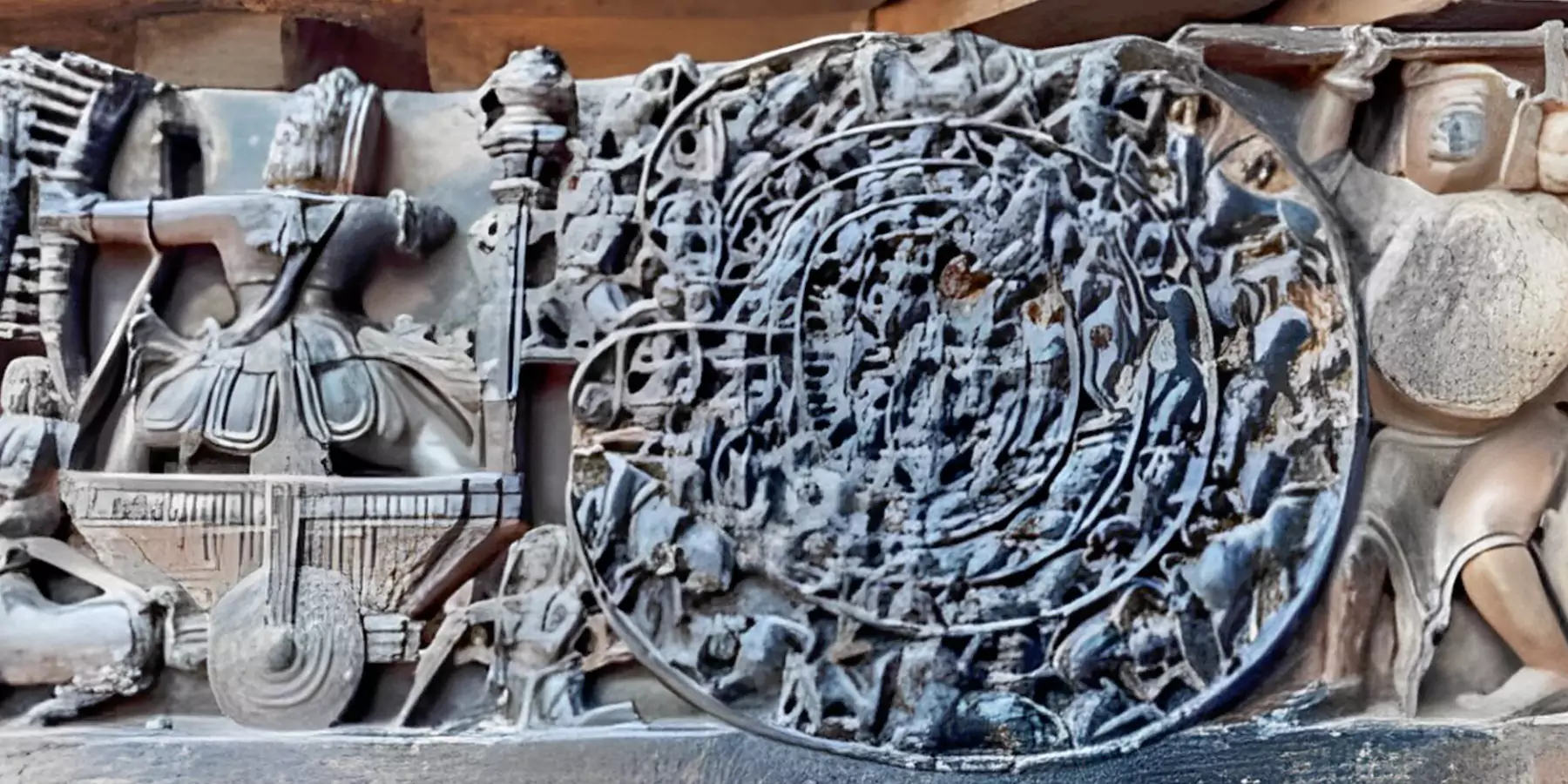
Warfare in Ancient Bharat: Part 2 of 2

This is the second of the 2-part essay that delves into the warfare rules of engagement, ethics, and overall perspectives in ancient Bharat. The essay is part of the academic requirement for the HUA course ‘Reconstructing Hindu History – The Omissions’ taught by Dr. Raj Vedam. The first part briefly introduced different works on warfare, when war is justified, different types of war, and ethics and rules of war.

This essay will cover the army composition, its organizational structure, troops distribution, war strategy, and weaponry.

Warfare in Ancient Bharat: Part 2 of 2

Army Composition

The army was considered one of the seven key elements of a state. According to Sukra Niti, what a mind is to man, an army is to a state. So, without an army, a state comes to a standstill. It also states, “There is neither kingdom, nor wealth, nor prowess. The treasury is the root of the army, and the army is the root of the treasury. It is by maintaining the army that the treasury and the kingdom prosper, and the enemy is destroyed.”

The ancient Hindu armies had a four-fold division called ‘caturanga-bala’ consisting of chariots, elephants, cavalry, and infantry in this order of prominence.

Chariots:

They were considered the most important in warfare. Sukra had mentioned of the iron chariot which consisted of swift-moving wheels, with good seats for the warriors and a seat in the middle for the charioteer and it was equipped with different offensive and defensive weapons. The Mahabharata had an elaborate mention of chariots.

Elephants:

Elephants are considered the next important force in the army. Greek ambassador Megasthenes explains how the elephants were hunted and tamed in Bharat. Some of the prominent works that deal with elephants are the Hastyayurveda of Palapakya and the Matangalila of Narayana. Roman historian Curtius Rufus mentions that the elephants created great terror and their trumpets frightened the Greek horses and their riders. They caused much disorder in the ranks, and veterans of many victories looked for shelter.

He also says that the most dismal sight was elephants gripping the Greek soldiers with their trunks, hoisting them above their heads, and delivering them to their soldiers to be beheaded. Similarly, Diodorus and Plutarch mentioned elephant warfare and their strength in the war between Alexander and Purushottam (Porus). According to Dhanurveda, the military training of elephants consists of mountaineering, moving through the water, running, jumping, rising, sitting, etc. The elephants should be made devoid of fear by putting them inside fire circles.

Cavalry:

The cavalrymen rode the horses with a whip that was fixed to the wrist unlike for the horses of a chariot. The cavalrymen were armed with bows and arrows or a spear or a sword. The cavalry had a wide range of tactical advantages. It was indispensable in situations requiring quickness of movement. Eminent works that deal with Horses and cavalry are Asva Sastra of Hemasuri and Asvacikitsa of Nakula.

Infantry:

According to the Agni Purana, victory attends to those armies where foot soldiers i.e., the infantry are numerically strong. The Sukraniti mentions foot soldiers possess firearms during combat. Dhanurveda mentions that the soldiers in an infantry should be of equal height and everyone in the infantry should be an expert in jumping and running. Moreover, they should be trained to move backward, stand still, run, and run apace rushing headlong into the hostile army, and move in different directions according to signals. According to Arrian, “They carry a bow made of equal length with the man who bears it.

This they rest upon the ground and pressing against it with their left foot, thus discharge the arrow having drawn the string backward: the shaft they use is little short of being three yards long, and there is nothing which can resist an Indian archer’s shot – neither shield nor breastplate nor any stronger defense if such there be”. Arrian also says, “All Indians are free. The Indian army was in constant pay, during war and peace. Arms and horses supplied by the state and army never ravaged the country. The bravery of the army is superior to any other army they had to contend with.”

Besides the four-fold classification of the army, Artha Sastra mentions a six-fold division. According to this division, the army consisted of six ‘limbs’ which are:

  • Maula (hereditary troops)
  • Bhrita (territorial army)
  • Sreni (organized militias)
  • Mitra (friendly troops)
  • Amrita (alien forces)
  • Atavi (jungle tribal forces)

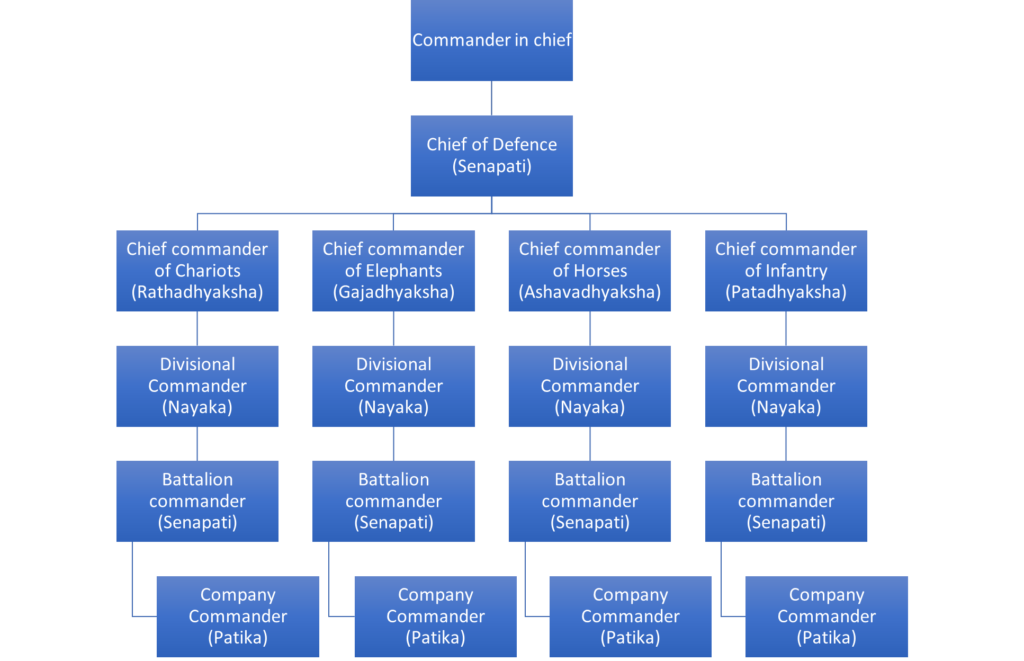
Army Organizational Structure

According to Artha Sastra, Army’s organizational structure is as follows:

  • Patika – Commander of ten units of the army.
  • Senapati – Commander of 10 Patikas.
  • Nayaka – Commander of 10 Senapatis.

Troop Distribution

Scriptures, such as The Mahabharata, mention the distribution of troops into nine different units namely: Patti, Senamukha, Gulma, Gana, Vahini, Pruthana, Chamu, Anikini, Akshauhini. Each unit consists of chariots, elephants, horses, and foot soldiers in the ratio of 1:1:3:5. The following table explains the composition of each unit taken from The Mahabharata, Aadi Parva (Adhyayam 2, verses 19-26).

Unit
Chariot
Elephant
Horse
Foot
Patti
1
1
3
5
Senamukha
3
3
9
15
Gulma
9
9
27
45
Gana
27
27
81
135
Vahini
81
81
243
405
Pruthana
243
243
729
1,215
Chamu
729
729
2,187
3,645
Anikini
2,187
2,187
6,561
10,935
Akshauhini
21,870
21,870
65,610
1,09,350

War strategy

There are several different types of military formations mentioned in Hindu scriptures. Some of these formations are: Padma Vyuha, Chakra Vyuha, Ratha Vyuha, Sarpa Vyuha, Garuda Vyuha, Simha Vyuha, Agni Vyuha, Danda Vyuha, Matsya Vyuha, Makara Vyuha, Sucimukha Vyuha, Sakata Vyuha, Vajra Vyuha etc. The type of vyuha (array) used shall depend on the type of anticipated attack.

Anticipated attack
Array used
In the front
Makara (Crocodile), Pipilika (Ant)
In the rear
Sakata (Carriage)
On the two flanks
Vajra (Thunderbolt)
On all sides
Sarvato badra (Uniformly circular), Danda (Staff)
If the path is narrow
Suchi (Needle)
Both sides from left and right
Varaha (Boar) or Garuda (Bird)

Weaponry

According to Dhanurveda, weapons fall into four categories based on their nature:

  • Mukta – which are thrown
  • Amukta – which are not thrown
  • Muktamukta – which are thrown or not thrown
  • Yantramukta – which are thrown by spells

Twelve weapons fall under the Mukta category: Dhanu (Bow), Arrow, Bindivala (Crooked club), Sakti (Spear), Drughana (Hatchet), Tomara (Tomahawk), Nalika (Musket), Laguda (Club), Pasa (Lasso), Cakra (Discus), Danta kantaka (Tooth-thorn), Musundi (Octagon-headed club)

The Amukta class consists of the following twenty weapons: Vajra (Thunderbolt), Hand sword, Parasu (Axe), Gosirsa (Cow-horn spear), Asidheny (Stiletto), Lavitra (Scythe), Astara (Bumarang), Kunta (Lance), Sthuna (Anvil), Prasa (Spear), Pinaka or Trisula (Trident), Gada (Club), Mudgara (Hammer), Sira (Ploughshare), Musala (Pestle), Pattisa (Battle-axe), Maustika (Fist-sword, Dagger), Parigha (Battering-ram), Mayukhi (Pole), Satagni (Hundred-killer)

The Muktamukta class weapons were further classified into two classes, namely Sopasamhara (connected with the withdrawing or restraining Upasamhara) and the Upasamhara themselves which are the restrainers of the previous class. There are forty-four varieties in the Sopasamhara class and fifty-four varieties in Upasamhara class.

There are only six weapons in the Yantramukta class, and nothing can defeat these six weapons.

  1. Visnuchakra (Discus of Vishnu)
  2. Vajrastra (Thunderbolt)
  3. Brahmastra (Brahma’s Missile)
  4. Kalapasaka (Noose of death)
  5. Narayanastra (Missile of Narayana)
  6. Pasupatastra (Missile of Pasupati)

Unlike Dhanurveda, the Agnipurana classified weapons into five categories. 1. Yantramukta, those thrown by a machine, 2. Panimukta, those thrown by the hand, 3. Mukta-sandharita, those thrown and drawn back, 4. Amukta, those which ate not thrown, and 5. Bahuyuddha, weapons that the body provides for personal struggle. Gustav Oppert in his monologue, ‘On the weapons, army organization and political maxims of the ancient Hindus, mentions that there are other classifications besides the previously mentioned.

Likewise, various treatises consist of different opinions regarding the superiority of one weapon over the other. For example, Vaisampayana in his Niti Prakasika had high regard for the sword whereas according to Agnipurana, it was considered a subaltern weapon where battles fought with bows are considered noble followed by fighting with spears, swords, and wrestling is considered the worst form of fighting. He also says that the efficiency of the weapons varies and is subject to great changes. Because of the construction mode, the materials used to make a weapon are different, and the quality of a weapon is not the same in different ages and places.

Besides, increasing, decreasing, and preserving the efficiency of a weapon depends a lot on the strength and ability of a person who uses such arms. One notable mention is that according to Gustav, gunpowder can be attributed to Niti Prakasika and Sukraniti. He also mentions that the gunpowder equivalent in Sanskrit is ‘agnicurna’ also called ‘curna’.

Conclusion

Hindu civilization had a rich knowledge of warfare, weapons, military strategies, and martial arts. This made the Hindu kings resist armed Islamic and Portuguese invasions in its history for the longest time which was nowhere to be seen across other civilizations in the world. Despite the mention of gunpowder in Hindu scriptures, and the training of elephants with fire circles to make them devoid of fear, we don’t witness any usage of fire weapons in Bharat’s armed struggle concerning Islamic invasions.

Moreover, Muslim historians recorded instances where naphtha balls were thrown against the rushing elephants and frighten them in wars between Rajputs and Turkish invaders from the North-West (Elliot and Dowson, vol. I). In any case, this rich knowledge combined with our ancestors rooted in Dharmic values led to the failure of total Islamization and the Christianization of Bharat.

References and Works Consulted

Chakravarti, P.C., The Art of War in Ancient India (General Printers & Publishers, 1941), University of Dacca. Accessed at https://archive.org/details/in.ernet.dli.2015.282006

Hema Hari, D.K. and Hari, D.K., Autobiography of India: Breaking the Myths – About Identity (Sri Sri Publications Trust, 2018), accessed at https://www.amazon.com/Autobiography-India-Identity-Breaking-Myths-Vol1-About-ebook/dp/B07C15GJMG

John C. Rolfe, Litt. D., Curtius Rufus, Quintus [History of Alexander], (Harvard University Press, 1946), University of Pennsylvania. Accessed at https://archive.org/details/quintuscurtius0002unse/page/n7/mode/2up

McCrindle J.W., Ancient India as described by Megasthenes and Arrian, (Thacker, Spink & Co., 1877). Accessed at https://archive.org/details/ancientindiaasd01mccrgoog/page/n6/mode/2up

Mookerji, Radha Kumud, Chandragupta Maurya and His Times, University of Madras, 1943. Accessed at https://archive.org/details/in.ernet.dli.2015.281321.

Oppert Gustav, NitiPrakasika, (Higginbotham And Co, 1882). Accessed at https://archive.org/details/in.ernet.dli.2015.217444

Oppert Gustav, On the weapons, army organization, and political maxims of the Ancient Hindus, (New Order Book Co, 1967). Accessed at https://archive.org/details/in.gov.ignca.46936

Rangarajan, L.N., Kautilya, The Arthashastra (Penguin Books, 1992). Accessed at https://archive.org/details/kautaliya-arthshashtra-ancient-India/mode/2up

Ramachandra Dikshitar, V.R., War in Ancient India (Macmillan & Co., 1944), University of Madras. Accessed at https://archive.org/details/in.ernet.dli.2015.503472

Ray, Purnima, Vasişţa’s Dhanurveda Samhitā (J.P. Publishing House, 2003). Accessed at https://archive.org/details/in.ernet.dli.2015.382701

Thippabhatla RamaKrishnaMurthy, Suram Srinivasulu., Shrimahabharatam aadiparvamu-sabhaparvamu-part-1 (Gita Press, Gorakhpur, 2018) Accessed at https://www.gitapress.org/bookdetail/shrimahabharatamu-aadiparvamu-sabhaparvamu-part-1-telugu-2141

Vittal, Vinay, “Kautilya’s Arthasastra: A timeless Grand strategy” (Graduate Thesis, Maxwell Air Force Base, AL. 2011). Accessed at https://apps.dtic.mil/sti/pdfs/AD1019423.pdf

Ancient Indian Warfare, accessed at https://www.worldhistory.org/Indian_Warfare/

Dhanurveda – Works on ancient Indian artilleries. Accessed at https://mahabharata-research.com/onewebmedia/chapter%203.pdf

Hindu Online, accessed at https://hinduonline.co/scriptures/dhanurveda/dhanurveda.html

Mahabharatam, in Telugu (Gita Press, Gorakhpur, 2016). First edition.

Surya’s Tapestry, accessed at https://www.hinduwisdom.info/War_in_Ancient_India.htm

We acknowledge the editorial assistance provided by Dr. Kalyani Samantray, Sri Sri University, Odisha, India.

Warfare in Ancient Bharat: Part 1 of 2

This is a two-part essay that delves into the warfare rules of engagement, ethics and overall perspectives in ancient Bharat. The essay is part of the academic requirement for the HUA course ‘Reconstructing Hindu History – The Omissions’ taught by Dr. Raj Vedam. The first part of the essay briefly introduces different works on warfare, when war is justified, different types of war, and ethics and rules of war. The second part, to be published soon, will cover the army composition, its organizational structure, troops distribution, war strategy, and weaponry.

Warfare in Ancient Bharat: Part 1

Ancient Bharat had witnessed many wars in every yuga be it Satya (Krita) Yuga, Treta Yuga, Dwapara Yuga, and Kali Yuga. Some of the famous wars were the war of ten kings, the war between Rama and Ravana in the Treta Yuga, and the Kurukshetra war in the Dwapara Yuga. Besides, many other wars were mentioned in various Puranas and many other wars were recorded in history. If Bharat had witnessed many such wars besides modern ones, it implies that Bharat had a rich history of warfare, weapons, and martial arts which might have evolved to higher functionality from rudimentary levels. This paper is an attempt to summarize ancient Bharat’s warfare and weaponry.

Works on Warfare 

Dhanurveda, one of the four upavedas and part of Yajurveda, deals with archery and military science. The other three upavedas are AyurvedaGandharvaveda, and Natyaveda, which are part of the Rig, Sama, and Atharvana Vedas respectively. The term ‘Dhanurveda’ usually denotes the artillery science. Dhanurveda mainly covers weapons and training, war ethics, war strategy, and army composition besides training horses, elephants, etc.

Moreover, Vasishta’s treatise on Dhanurveda, called Dhanurveda Samhita, and Nitiprakashika by Vaisampayana deal with the same. Agni Purana also deals with weapons. The Vishnu Purana mentions Dhanurveda as one of the eighteen traditional branches of knowledge. In addition to the mention of training horses and elephants in Dhanurveda, there are works like Asva Sastra, Asvacikitsa, Hastyayurveda, and Matangalila that explicitly deal with elephants and horses. Arthashastra by Kautilya was based on several earlier treatises, and teachers like Vishalaksha and Bharadwaja deal with politics, state administration, warfare, military strategies, other essential aspects of war, etc.

According to L. N. Rangarajan, the author of the book ‘Kautilya-The Arthashastra’, there were a minimum of four distinct schools of thought and thirteen individual teachers of Arthashastra before Kautilya. Other notable works that fall into the category of Arthashastra are Sukra Niti by Sukracharya, Kamandakiya Nitishastra, Harihara Caturanga, Sangrama-Vijayodaya, etc. 

War and Types of War

In Sanatana Dharma, wars are fully justified as an integral part of dharma. War is completely acceptable if it is fought to uphold Dharma or to protect the weak and the innocent. According to Manu and Kautilya, wars were fought not only for self-defense against external aggression but also for the territory’s enlargement by conquest. Moreover, they explain that a king aims to destroy a natural enemy because if he does not eliminate the enemy, he will be eliminated by the enemy.

It can be widely seen that war was always used as a last resort after exhausting all the measures to maintain peace, which is evident from Ramayana, Mahabharata, and other such scriptures. The ancient Hindu society realized the importance of peace and hence followed a four-stage process to avoid war and settle disputes. These stages are:

  • Sama – peaceful negotiation
  • Dana – offering gifts appeasing the enemy
  • Bheda – veiled threat
  • Danda – use of force

According to ancient Hindu society, war was not just confined to physical war. War was classified into four kinds by Kautilya, who is also called Chanakya in Artha Sastra.

  • Mantrayuddha – war by counsel employed by a weaker king when waging an open war is not a good idea
  • Prakasayuddha – open war
  • Kutayuddha – a concealed war that meant irregular warfare and psychological warfare, including the instigation of treachery in the enemy camp
  • Gudayuddha – using covert methods to achieve the objective without waging a battle

In one of the strategies employed by the ancient Bharatiya kings that fall under Gudayuddha, gifts were sent to the invading kings, which also included the Poison Maiden (Visha Kanya) to kill the enemy king. In a letter (Latin – Elgood, Arabic translation by Al-Batriq) written by Aristotle to Alexander cautioning him about a Poison Maiden, he says “Remember what happened when the king of India sent three rich gifts and among them that beautiful maiden whom they had fed on poison until she was the nature of a snake.

Had I not perceived it because of my fear, for I feared the clever men of those countries and their craft, and had I not found by proof that she would be killing thee by her embrace and by her perspiration, she would surely have killed thee.”   

Ethics and Rules of War in Ancient Bharat

During a war, Hindu kings abided by certain ethics which were mentioned in several ancient scriptures mentioned previously. Even accounts of Greek scholars mentioned that wars in Bharat were fought between kings and armies and no civilians were harmed in this process. Greek ambassador Megasthenes mentions, “Whereas among other nations it is usual in the contests of war to ravage the soil and thus reduce it to an uncultivated waste, among the Indians, on the contrary by whom husbandmen are regarded as a class that is sacred and inviolable, the tillers of the soil, even when in battle is raging in the neighborhood, are undisturbed by any sense of danger, for the combatants on either side in waging the conflict make carnage of each other, but allow these engaged in husbandry to remain unmolested.

Besides they neither ravage an enemy’s land with fire nor cut down its trees. Nor would an enemy coming upon a husbandman’s at work on land do him harm, for men of this class, being regarded as public benefactors, are protected from all injury”. This kind of war code was employed in the western world through the Geneva convention in 1949.

War Ethics and rules of engagement in the Mahabharata, Ramayana, Dhanurveda, and Vedas:

  • The place and time of war must be specified beforehand to be in accordance with dharma.
  • War is to begin at sunrise and end at sunset.
  • A single warrior cannot be attacked by multiple warriors.
  • When two warriors engage in a duel, they shouldn’t be intervened.
  • A surrendered warrior should be unharmed.
  • A surrendered warrior becomes a prisoner of war and is subject to the protections allocated to such a warrior.
  • An unarmed warrior cannot be harmed.
  • Anyone (human or animal) not involved in the war should be left unharmed.
  • Unless considered a direct threat, animals in battle cannot be killed.
  • A warrior involved in a battle with a weapon should abide by certain rules. For example, striking the enemy with a mace below the waist was forbidden.
  • Warriors should not be engaged in an unjust war; it had to be a just war.
  • Land should not be harmed in any form.
  • Women, children, the sick, and farmers should not be affected in a battle and war prisoners were considered sacred.
  • A warrior should not be struck from the back.
  • Poisoned weapons and arrowheads were forbidden.
  • Mass destruction weapons that wiped off the entire population were prohibited.
  • An enemy who is lying unconscious, who is crippled, who does not have a weapon or is stricken with fear, and who came for asylum should not be killed.
  • A strong and brave warrior should not chase and kill any fleeing enemy stricken with fear.

When a territory is acquired by conquest, the conqueror king shall:

  • Be twice as good as the previous king.
  • Follow policies that are pleasing and beneficial to the constituents by acting according to his dharma.
  • Adopt the way of life, dress, language, and customs of the people of the acquired territory, show the same devotion to the gods of the territory as to his own gods and participate in the people’s festivals and amusements.
  • Ensure the practice of all customs which are in accordance with dharma.
  • Ensure that worship is held regularly in all the temples and ashrams.
  • Grant land, money, and tax exemptions to the men distinguished for their learning, speech, dharma, or bravery.
  • The ill, the helpless, and the distressed shall be helped.

When the enemy camp is raided, these people should not be attacked:

  • Anyone falling in the fight.
  • Those turning their backs.
  • Anyone surrendering.
  • Anyone who unties his hair as a symbol of surrender or throws his weapons down.
  • Anyone contorted by fear.
  • Anyone who does not fight.

Furthermore, Manu Smriti also has some battle rules:

  • The conqueror has the obligation of treating the defeated ones with humanity.
  • A warrior should not strike with weapons concealed nor with barbed, poisoned, or the points of which are blazing with fire.
  • People walking on the road, travelers, or those who are engaged in eating and drinking or pursuing their activities and Brahmans should not be harmed unless engaged in a war.
  • Combat between the mounted and the unmounted was prohibited.
  • Combat between warriors of officer rank and foot soldiers was not allowed.
  • Collective attacks against a single soldier and the slaying of a warrior who had a temporary disadvantage during the battle were strictly prohibited

Despite multiple treatises pointing out the act of using poisoned weapons as cowardly, Dhanurveda had techniques of Phalapayana, a technique to make arrows poisonous. One of the recorded instances where poisonous swords and arrows were used was in the battle between King Sambus and Alexander where Ptolemy, the Greek general of Alexander was wounded by a poisoned arrow. Moreover, many soldiers who were wounded by poisoned swords, and arrows died soon after.

References & Works Consulted

Chakravarti, P.C., The Art of War in Ancient India (General Printers & Publishers, 1941), University of Dacca. Accessed at https://archive.org/details/in.ernet.dli.2015.28200

Crindle, J.W.M., The Invasion of India by Alexander the Great, (Westminster Archibald Constable and Company, 1896). Accessed at https://archive.org/details/invasionindiaby00arrigoog/mode/2up

Hema Hari, D.K. and Hari, D.K., Autobiography of India: Breaking the Myths – About Identity (Sri Sri Publications Trust, 2018), accessed at https://www.amazon.com/Autobiography-India-Identity-Breaking-Myths-Vol1-About-ebook/dp/B07C15GJMG

Modi, Jivanji Jamshedji, Asiatic Papers, Part IV, (Times of India Press, 1929). Accessed at https://archive.org/details/in.ernet.dli.2015.30255.

Mookerji, Radha Kumud, Chandragupta Maurya and His Times, University of Madras, 1943. Accessed at https://archive.org/details/in.ernet.dli.2015.281321.

Ramachandra Dikshitar, V.R., War in Ancient India (Macmillan & Co., 1944), University of Madras. Accessed at https://archive.org/details/in.ernet.dli.2015.503472

Rangarajan, L.N., Kautilya, The Arthashastra (Penguin Books, 1992). Accessed at https://archive.org/details/kautaliya-arthshashtra-ancient-India/mode/2up

Ray, Purnima, Vasişţa’s Dhanurveda Samhitā (J.P. Publishing House, 2003). Accessed at https://archive.org/details/in.ernet.dli.2015.382701

Vittal, Vinay, “Kautilya’s Arthasastra: A timeless Grand strategy” (Graduate Thesis, Maxwell Air Force Base, AL. 2011). Accessed at https://apps.dtic.mil/sti/pdfs/AD1019423.pdf

Dhanurveda – Works on ancient Indian artilleries. Accessed at https://mahabharata-research.com/onewebmedia/chapter%203.pdf

Hinduwebsite, accessed at https://www.hinduwebsite.com/hinduism/h_war.asp

Hinduwebsite, accessed at https://www.hinduwebsite.com/ask/is-war-justified.asp

Sanskriti Magazine, accessed at https://www.sanskritimagazine.com/indian-religions/hinduism/hinduism-code-ethics-war/

Hindu Online, accessed at https://hinduonline.co/scriptures/dhanurveda/dhanurveda.html

Surya’s Tapestry, accessed at https://www.hinduwisdom.info/War_in_Ancient_India.html

We acknowledge the editorial assistance provided by Dr. Kalyani Samantray, Sri Sri University, Odisha, India.

Mitra! Ask me anything!