









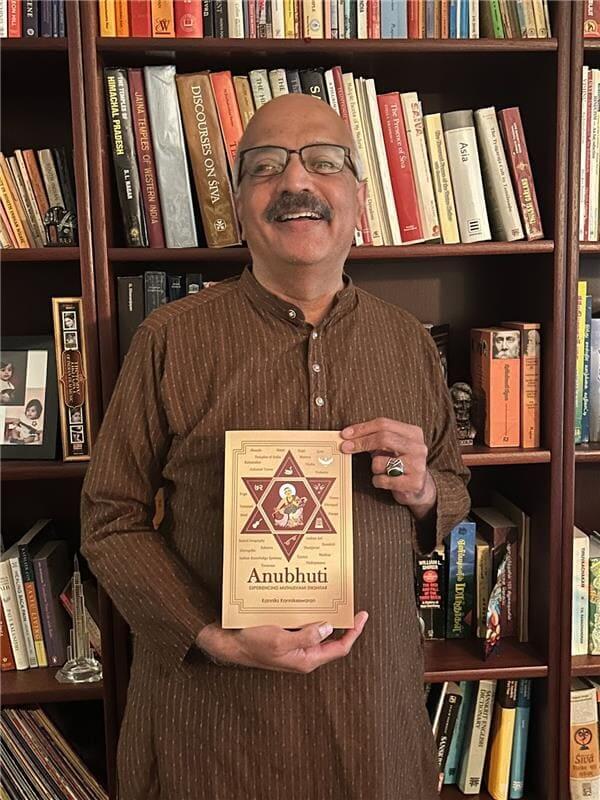
As a lifelong devotee of Muthuswami Dikshitar, it is with immense gratitude and excitement that I share my new book, Anubhuti, released on the occasion of his 250th birth anniversary. This book is more than just a historical account; it’s a statement of my perspective, an offering born from decades of research and a deep, personal connection to his extraordinary genius.
For too long, Dikshitar has been primarily viewed through an academic lens. While the rich archives of institutions like the Music Academy and the array of concerts in the Chennai Music Season celebrate the performance tradition, my aim with Anubhuti is to celebrate the vision and the profound experience—the anubhuti—of Dikshitar himself. I want to showcase this unique genius to a wider audience—anyone interested in history, India, and perhaps, a deeper understanding of music. I also hope to bring the incredible wealth of India’s temple heritage to the forefront, as it is so intrinsically woven into his work. Dikshitar (1775-1835) was a towering figure, but he was so much more than a composer. He was a traveler, a poet, and a civilizational visionary. His Sanskrit compositions are a stunning fusion of temple heritage, tantric traditions, and pan-Indian philosophies. Imagine a mind so vast that it drew from the Puranas, Itihasas, Jyotisha Shastra, Mantra-Shastra, Vedanta, Srividya Tantra, Tevaram liturgical music, Shastriya Sangit traditions and even colonial music, creating music that reflects profound Hindu thought and ancient prosody, bridging regional and pan-Indian expressions.
In Anubhuti, I invite you to join me on a journey through his travels across India, mapping the geographic and spiritual inspirations behind his works. We’ll explore his rich cultural synthesis during colonial rule, a time when he had the audacity to share his message even through the medium of colonial music. His ultimate example of decoloniality, in my view, is his repurposing of the British National Anthem tune as a stuti (praise) on Devi from the paradigm of advaita.(Trailer). This book narrates all of this and, I believe, offers a perspective on Dikshitar that has not been highlighted before.
I see Dikshitar as a scholar, an Advaitin, a travel blogger, a relentless and fearless traveler, a compassionate guru, and a tireless teacher whose every composition is a masterclass in storytelling. He was a perfectionist, incredibly well-educated in Ayurveda, Jyotisha, literature, language, Sangita Shastra, and the arts—a true polyglot with a global perspective. His single-minded focus was on disseminating information about Indian culture, temples, and worship traditions from an Advaitic perspective.
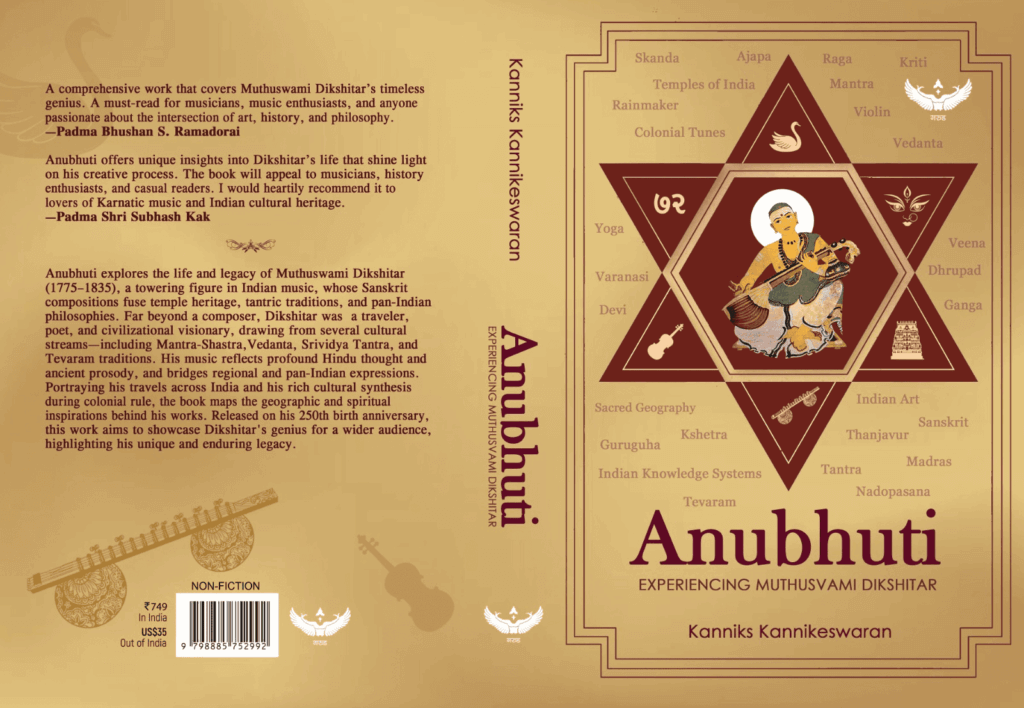
Anubhuti sets the context for Dikshitar’s music within the overall scheme of shastriya sangit and contextualizes his life against the backdrop of the early colonial era. It showcases the incredible diversity and variety in his repertoire, highlighting unique intricacies and placing the narratives in his compositions within a pan-Indian context. We delve into the underlying theme of Advaita Vedanta and temple traditions, even in his music based on colonial tunes, and explore his deep connection with Kashi and other pan-Indian traditions.
I draw clear parallels between Adi Sankara’s Shanmata (the six streams of worship) and Dikshitar’s work, and highlight his dig-vijaya, or travels, in the context of early, contemporary, and later travelers. We discuss the mysticism in his life and the tantric traditions he embraced, ultimately showcasing his role as an integrator and innovator.
This book is my humble tribute in the 250th year of his birth, a call for everyone to read about this extraordinary figure. Anubhuti is rich in symbolism, much like his compositions, right from its cover. It highlights several cross-cultural connections and is a reflection of my own deep connection with the composer and the influence his music has had on my own work.
Dikshitar was a historian, a travel blogger, an unconventional musician, a poet, and a civilizational votary—all in one. His creations in Sanskrit, presented in a stunning range of melodies, represent an unspoken story: the story of India’s temple heritage, a complex tapestry of pan-Indian ideas interwoven with local traditions, puzzling palindromes, archaic prosodical constructs, and deep Hindu philosophy.
Published by Garuda Prakasan, New Delhi, Anubhuti is the first book on the composer released this year, and I hope it will ignite a new appreciation for his enduring legacy.As a lifelong admirer of Muthuswami Dikshitar, I am thrilled to share my new book, Anubhuti, released to mark his 250th birth anniversary. This book isn’t just a historical account; it’s my personal perspective, the culmination of decades of research and a deep, personal connection to his extraordinary brilliance.
On the occasion of Vijaya Dasami 2025, even as this work is getting published, I offer my pranams and dedicate this to all the purvikas who have shared their knowledge of Dikshitar in the past several decades.
About the Author:

Dr. Kanniks Kannikeswaran is an internationally renowned music composer, educator, and scholar. He is celebrated for his sustained contributions to music and community over the past 25 years. His collaborations include prominent artists such as Bombay Jayashri, Kaushiki Chakraborty, and the Cincinnati Pops Orchestra. His trilogy of viral music videos on water resources composed and produced for the International Center for Clean Water, IIT Madras have had a wide reaching impact. Kanniks is the recipient of numerous awards, including the Ohio Heritage Fellowship and the Distinguished Alumnus Award from IIT Madras. His film “Colonial Interlude” received the “Best Short Documentary Film” award at the Indian Film Festival Cincinnati 2023 and the ‘Best Documentary Film’ award at the Indian International Film Festival, Boston. Maestro John Morris Russell—Director of the Cincinnati Pops Orchestra—describes it as “…an extraordinary story that I knew nothing about. It has really changed my view about music making and the power of music to bring people together.” “Anubhuti” stands as Kannikeswaran’s humble tribute to Dikshitar, a reflection of a profound lifelong connection.
Copies of the book may be ordered here.