









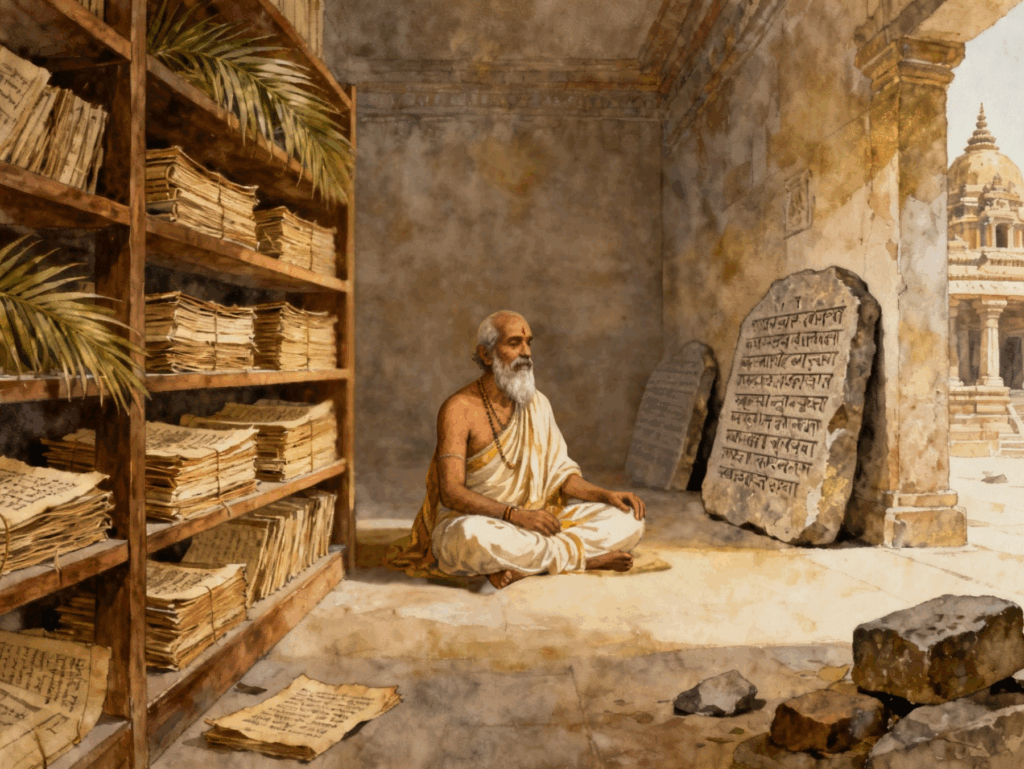
“Until the lions have their own historians, the history of the hunt will always glorify the hunter.“
– Chinua Achebe
In the history books of today, the story of modern civilization allegedly begins in the areas adjacent to Europe–namely Babylonia and Egypt. These civilizations were succeeded by ancient Greece, which would go on to single handedly inspire much of the West’s philosophy, medicine, astronomy, and mathematics. The narrative continues with the notion that surviving translations of Greek works would later ignite the Renaissance, leading Europe to the Industrial Revolution, and subsequently to its economic, technological, and military dominance throughout the world. This phenomenon of Europe’s ascendance is called The Great Divergence, or The European Miracle, and scholars continue to ponder the reasons behind it. Historical frameworks going back over two centuries have been mostly Eurocentric, built on the assumption that racial superiority and Christianity are what catapulted Europe to global leadership. However, these frameworks are being actively questioned as new research brings startling information to light. It appears that Hindu civilization, whose role in shaping the progress of humanity has been largely omitted from the history books, must take its rightful place in order for modern society to accurately understand itself. However, entrenched academics in Indology, along with other forces, are actively preventing this new information and new paradigms from gaining traction in the public sphere.
In his landmark book “The Structure of Scientific Revolutions,” Thomas Kuhn outlined the Kuhn Cycle for paradigms and defined a paradigm as a set of generally accepted models, theories, and assumptions with which a scientific community approaches its work. Once a paradigm has been established, he suggested that there is a phase called “normal science,” in which any anomalies that do not conform are tolerated but the prevailing paradigm is not criticized. In fact, Kuhn argued that there is a certain inertia within the community because any individual scholar who “joins men who learned the bases of their field from the same concrete models […] will seldom evoke overt disagreement over fundamentals. Men whose research is based on shared paradigms are committed to the same rules and […] the apparent consensus it produces are prerequisites for normal science, i.e., for the genesis and continuation of a particular research tradition” (11).
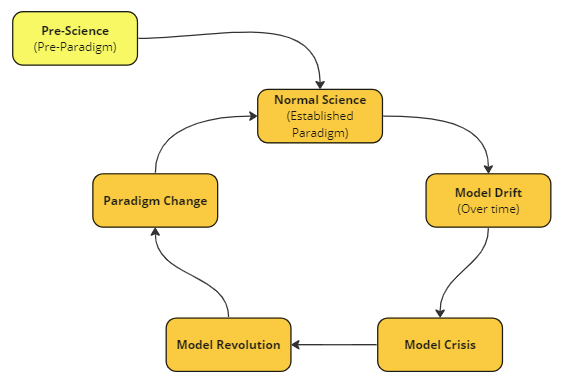
If certain anomalies continue to be inexplicable by the existing paradigm, then the amount of accumulating counter-evidence leads to model drift. Eventually, the scholarly community can no longer ignore these aberrations and the next stage in the Kuhn Cycle, a model crisis, begins to develop. During this time, there will be a growing realization that the incumbent paradigm will need to be replaced by a different framework. It is also during this period, before new theories can take hold, that there is “a period of pronounced professional insecurity” (Kuhn 67). At times, the pressure of the incumbent tradition to preserve itself may be so great that its members decide to resort to unethical behaviors, ironically undermining the credibility of the incumbent paradigm (Danino).
Likening the development of scientific revolutions to political revolutions, Kuhn describes the atmosphere at this point:
At that point the society is divided into competing camps or parties, one seeking to defend the old institutional constellation, the others seeking to institute some new one. And, once that polarization has occurred, political recourse fails. Because they differ…the parties to a revolutionary conflict must finally resort to the techniques of mass persuasion…this issue of paradigm choice can never be unequivocally settled by logic and experiment alone. (93-94)
The model revolution eventually takes place, where the existing model is supplanted by a new one. This transition may not happen quickly though. It may take a full generation or even decades for a new crop of scholars to rise up within a field who are not as attached to the old model. For example, the Copernican astronomy model did not immediately gain traction after the publication of his work. Darwin’s theory of evolution also was not immediately embraced. Such is the nature of progress in the physical sciences and the social sciences. However, there eventually is a tipping point where a paradigm change happens: the incumbent paradigm is destroyed and the new one takes hold in the broader scholarly community. This process occurs when the new model begins to be outlined in textbooks and beyond, becoming widely disseminated.
Today, according to groundbreaking research done by some scholars, we find that there is a wide chasm between the incumbent narrative of Indian history and what it needs to be, in light of the new information. Aside from the inertia outlined in the Kuhn Cycle, there are other forces in play that are preventing new models of Indian history from gaining traction. “Almost all you have in academic textbooks about ancient India is either superficial, banal, half-truths or plain wrong…it is a racist enterprise…in which the stated objective is to teach Indians [and Hindus that]…they never developed scientific or critical thinking…” (Kak). Such a scathing critique is far from isolated. The emic, or insider, perspective of the indigenous Hindu civilization has been systematically silenced or sidelined via baseless ad hominem attacks from entrenched academics and their politically oriented allies.
One may wonder how we can even begin to close this wide chasm between the current historical narrative and the obvious, more elegant narrative that is waiting to be adopted. This transition becomes achievable if we apply our understanding of the Kuhn Cycle to the various incumbent models that compose the current narrative. Strategically challenging each of these paradigms and successfully displacing them with the new, more robust models will someday change the entire narrative of the Hindu civilization and rewrite the story of its contributions to the world in terms of philosophy, astronomy, medicine, and mathematics.
The first paradigm that needs to be destroyed is the Aryan Invasion Theory/ Aryan Migration Theory (AIT/AMT). The AIT model encountered enough model drift that it had to be updated to the AMT. Note that the AMT was not the result of a model revolution or paradigm change as outlined in the Kuhn Cycle. The AMT was only an adjustment to the incumbent AIT paradigm and still contains the same racist assumptions, which lead to the same faulty conclusions as before. The hope of the current Indology establishment was that this updated paradigm would allow the continuation of the normal science stage to continue. However, enough model drift has taken place even with AMT that it now finds itself squarely in the crisis stage. Supporters of this paradigm continue in their efforts to manufacture or distort evidence that will protect their stance. For example, geneticist David Reich of Harvard University has published a paper where he artificially divides the genes of India’s population into two camps: Ancestral North Indian (ANI) and Ancestral South Indian (ASI). He then astonishingly admits in the same paper that “groups with only ASI ancestry may no longer exist in mainland India” (Reich). By that very statement, he has invalidated his categories and the existence of two different genetic populations in India.
At this time, a simpler, alternative model to the above emerges: there was no mass migration into ancient India from the steppes of Central Asia. In fact, the last mass migration into India was over fifty thousand years ago and originated from Africa. Once adopted, this new model would have several important consequences. First, the existence of a fictitious Proto-Indo-European homeland would be disproved. Second, the purely manufactured myth of a parent Proto-Indo-European (PIE) language would be forsaken. Third, the racist, European-created Aryan/Dravidian divide would collapse. And finally, the dating of the Rig Veda, which was arbitrarily placed at 1500 BCE by Max Muller, would be pushed back much earlier in time to conform with archaeological, geological, literary, and astronomical evidence. No doubt, this new paradigm would force Europeans to confront an uncomfortable question that they have avoided answering for almost 250 years: are their ancestors originally from India?
The second paradigm that needs to be displaced is the common understanding of what happened to the Indus-Saraswati Civilization around 2000 BCE. The current paradigm involves the AMT and how migrating bands of Aryans from Central Asia to India eventually led to the downfall of this advanced civilization. This framework is clearly in the model crisis stage because geological evidence points to the Saraswati River ceasing to flow to the Indian Ocean in 3000 BCE and its drying up around 1900 BCE. This was due to a two hundred year drought that forced some Indians to migrate westward to the Fertile Crescent of Mesopotamia and others to migrate eastward to the Gangetic Plain. The consequences of this new paradigm would be to drive the last nail into the coffin of the AIT/AMT. It would also serve as one of many indications that point to a transmission of Indian knowledge westward to Babylonia, eventually paving the way for it to travel to Europe.
The third paradigm to replace is that the Renaissance was entirely the result of tremendous leaps in thought by European thinkers, all within the span of only two hundred years. The racist view that non-white civilizations did not contribute anything to the Renaissance is embodied in modern textbooks. This paradigm may take the longest time to displace as it is multi-faceted and is only moving into the model drift stage today. Mounting evidence suggests that the transmission of Indian knowledge to Europe in the areas of philosophy, medicine, mathematics, and astronomy occurred for over three thousand years. During the brutal Islamic conquest of India, much Indian knowledge was lost. However, in other instances, knowledge was forcibly extracted from India as the Islamic world translated hundreds of thousands of manuscripts from Sanskrit to Arabic and Persian. When the Baghdad House of Wisdom was burned down in 1258 CE by the Mongols, many of these translated works were smuggled into Europe, where they were translated into Latin by monks at the Toledo school of translation in Spain. Whether it is Descartes, Spinoza, Newton, Leibniz, or any number of European luminaries, the new paradigm will show that they all either heavily borrowed Hindu concepts or were heavily influenced by them. In fact, a consequence of this new framework will be the realization that the flowering of Europe during the Renaissance and its subsequent Industrial Revolution would not have been possible without Indian herbs, its decimal system, its arithmetic methods, geometry, trigonometry, calculus, and innumerable other contributions.
In the coming years, if the incumbent paradigms outlined above are successfully replaced by others that better satisfy the mountains of evidence available to us, we will witness a revolution in how we understand ourselves. The history of the world will have a refreshing, new narrative that is free from the racist theories currently entrenched in Indology circles and we will no longer have such a myopic view of human progress.