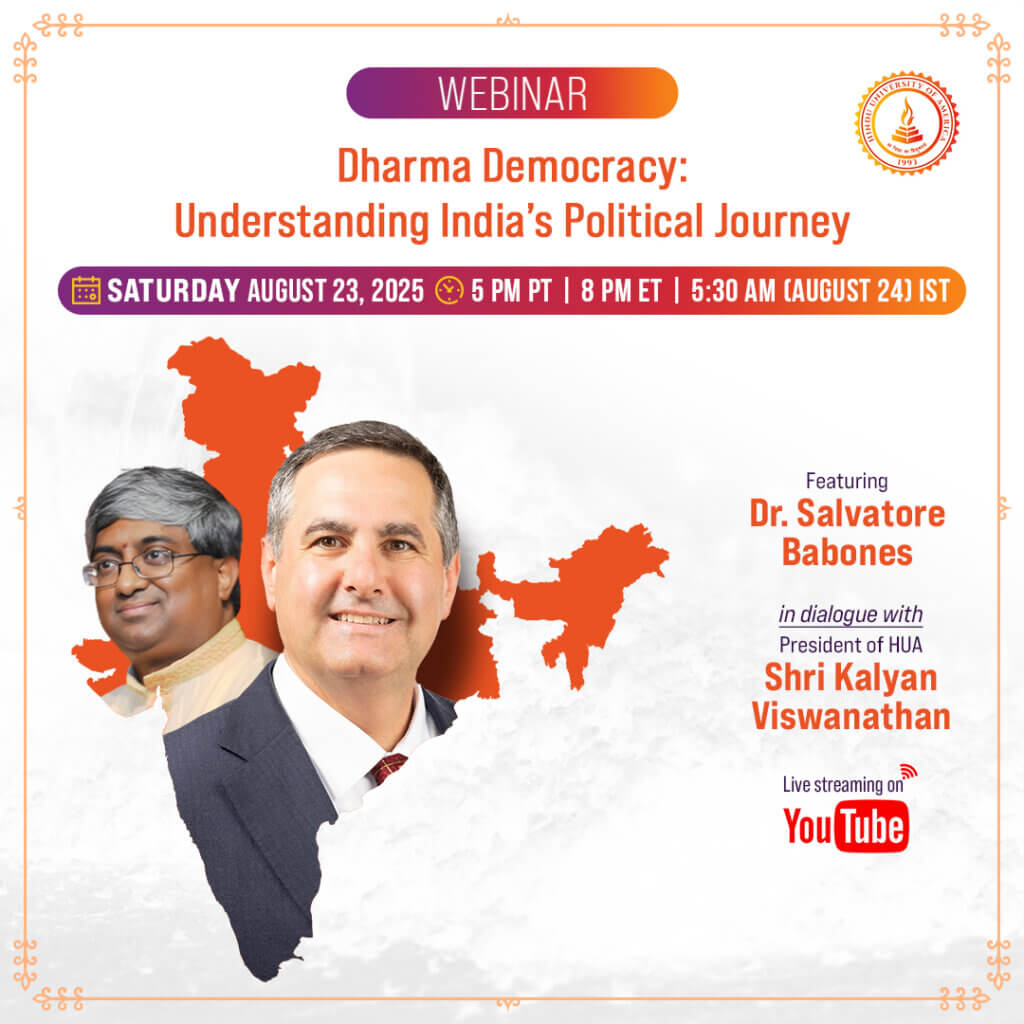
Dharma Democracy: Understanding India’s Political Journey
Recent Webinar: Saturday, August 23, 2025, 5 pm PT / 8 pm ET / 10 am AEST / 5:30 am IST (Sunday)
About the Webinar:
India is often hailed as one of the world’s greatest democratic success stories, but how does its democracy actually function in practice, and what makes it unique? In this special webinar, renowned comparative sociologist Dr. Salvatore Babones will discuss and explore India’s democratic evolution through the lens of his acclaimed book Dharma Democracy.
Drawing on rigorous quantitative data, primary historical sources, and a keen understanding of India’s civilizational heritage, Dr. Babones offers a clear-eyed, balanced assessment of the strengths, challenges, and resilience of Indian democracy. He contrasts India’s performance with established Western democracies while situating it firmly in its own Hindu civilizational and historical context.
Challenging prevailing academic narratives shaped by ideological biases, Dr. Babones argues that India’s Hindu civil society has been a pillar supporting democratic institutions. He traces the transformation from India to Bharat, exploring the idea of “dharma democracy”: a model of nation-building rooted in shared political community, civilizational continuity, and the practice of self-governance.
Whether you are a scholar, policymaker, or simply curious about the world’s largest and most argumentative democracy, this webinar will leave you with a fresh perspective on India’s political life beyond the headlines and outside the echo chambers.
Get to Know panelists
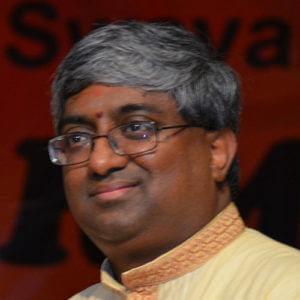
Sri. Kalyan Viswanathan
Sri. Kalyan Viswanathan serves as the President of HUA. He holds a Master’s Degree in Computer and Information Science from Ohio State University. He was associated with Pujya Swami Dayananda Saraswati of the Arsha Vidya Gurukulam for 21 years.
Dr. Salvatore Babones
Dr. Salvatore Babones, Associate Professor at the University of Sydney, is a political sociologist whose research highlights India’s democratic evolution, governance, and role in the global order. Author of Dharma Democracy: How India Built the Third World’s First Democracy (2025), he is a prominent voice in Indian public discourse, contributing regularly to national and international media on India’s politics and development.
Course Offered by Panelist at HUA
-
Orientation to Hindu Studies
HSF5000 – (CPHS Required Course) To understand the roots of Hinduism which for many thousands of years has kept the fundamentals of Sanatana Dharma alive, the Veda must be understood in its essence. There have been several attempts to discover the true sense of the Vedic Mantras. Yet the Veda has been misunderstood, misinterpreted, and presented to contemporary humanity in a way that has lost its essential meaning. Even today there remains a wide gap in our understanding of what the Veda meant to convey. This course on the Vedic Origins of Hinduism will examine various interpretations of the Veda and seek to enter the spirit of the seers of the Veda. It will provide students with a deep insight into the uninterrupted continuity of Hindu thought as it unfolded across the millennia, keeping the foundational values of the civilization alive from generation to generation.
This Course is an important point of entry into the entire curriculum offered by HUA and a prerequisite for all Graduate level programs.
Select options This product has multiple variants. The options may be chosen on the product page
Talks by Sri. Kalyan Viswanathan
Recent Blogs by HUA
The Hidden Rhythm
An HUA student demonstrates how he gained profound insights which deeply enhanced their classical dance artistry and performances, by studying the cultural, historical, and spiritual aspects through our specialized Hindu...
Read Full BlogMy Experience at the 19th World Sanskrit Conference
Dr. Ashutosh Pareek, a visiting HUA Sanskrit faculty shares his enriching experience at the 19th World Sanskrit Conference in Nepal, highlighting global scholarly exchanges, Sanskrit revival efforts, and the timeless...
Read Full Blog