









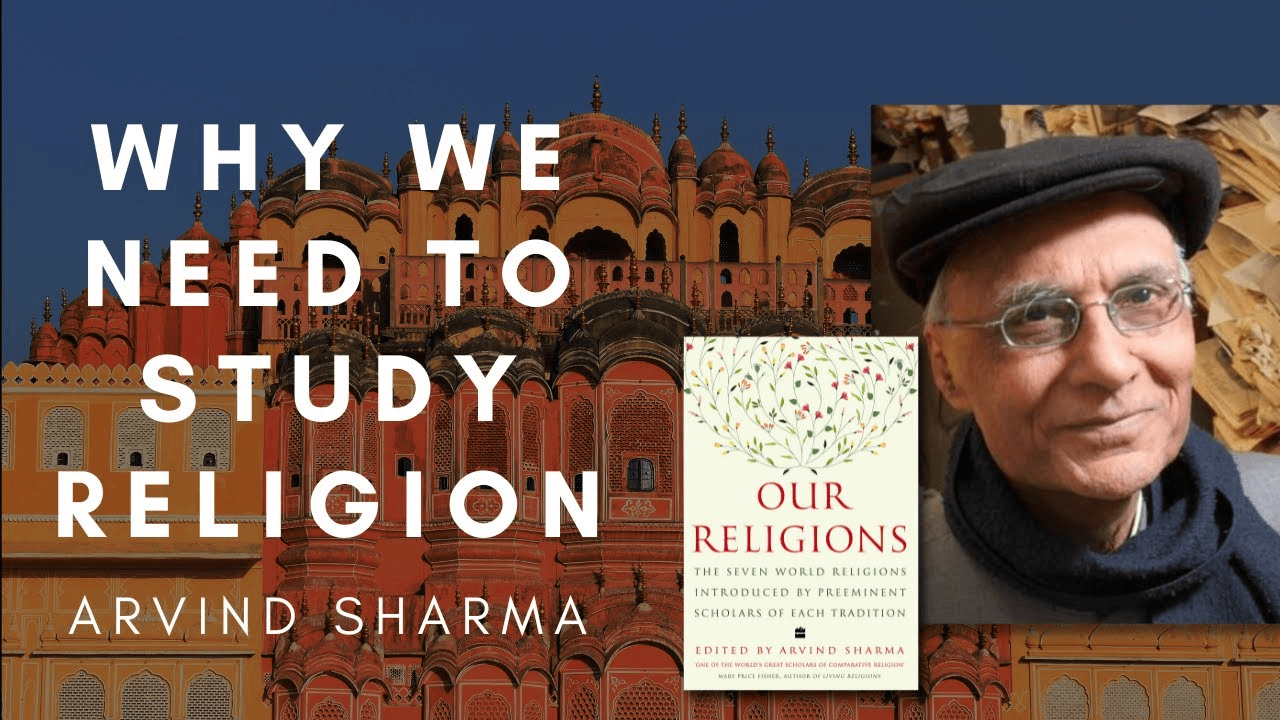
Professor Arvind Sharma was a Scholar, Civilizational Thinker, and a Pioneer in decolonizing Hindu Studies. His passing marks the departure of one of the most distinguished scholars of Hinduism and comparative religion of our times. For those of us engaged in recovering, renewing, and transmitting Hindu knowledge traditions within the modern university, his passing has particular significance. We have lost not merely a prolific scholar, but an important bridge between the Hindu tradition and the modern academy. His career was dedicated to the potential for dialogue between the practitioner’s study of his or her own religion, and the academic study of another’s religion as an outsider.
Professor Sharma’s intellectual journey was itself remarkable. Born in India in 1940, he began his professional life in the Indian Administrative Service, serving in Gujarat. He subsequently left what could have been a distinguished career in public administration to return to the life of the mind. After graduating in economics at Syracuse University, his intellectual inquiry increasingly drew him towards the study of religion. He earned a Master of Theological Studies from Harvard Divinity School and subsequently a Ph.D. in Sanskrit and Indian Studies from Harvard University.
After teaching in Australia and at several universities in the United States, he eventually joined McGill University in Montreal, where he became the Birks Professor of Comparative Religion. Over several decades, he emerged as one of the most prolific scholars of Hinduism, comparative religion, Advaita Vedānta, religious pluralism, women and religion, and the relationship between Hindu civilization and the categories through which the modern academy has represented it. But a list of positions, publications, and academic accomplishments does not adequately capture the importance of Professor Sharma’s contribution.
In my view, his deeper contribution lay in the questions he was willing to ask. Modern Hindu Studies emerged largely within intellectual frameworks developed outside the Hindu tradition. Hindu civilization became an “object” of study, interpreted through categories such as “religion,” “mythology,” “caste,” “race,” ritual,” and “social hierarchy.” These categories were often treated as self-evident and universal, while the categories through which Hindus had understood themselves—Dharma, Mokṣa, Ātman, Brahman, Yoga, Varṇa, Āśrama, Śāstra, Sampradāya, Darśana, and many others—were frequently translated, reframed, or subordinated to categories originating elsewhere.
Professor Sharma increasingly turned his attention to this fundamental problem. Who has the authority to describe a civilization? Through whose categories should a tradition be understood? Can Hinduism be studied adequately without taking the self-understanding of Hindus themselves seriously? What happens when the observer’s categories become more authoritative than those of the civilization being observed? These questions have become increasingly important to the field of Hindu Studies, and especially to the work we undertake at Hindu University of America.
Professor Sharma understood that intellectual decolonization does not mean rejecting Western scholarship. Nor does it mean retreating from critical inquiry. Rather, it requires enlarging the intellectual space within which inquiry takes place. It requires allowing Hindu categories, Hindu texts, Hindu practitioners, and Hindu modes of knowing to help define the terms of the conversation. This distinction is enormously important.
“He viewed the task before Hindu Studies as creating a genuinely pluralistic intellectual environment in which Hindu traditions are not merely objects to be examined from the outside but knowledge traditions capable of speaking in their own voice.”
Professor Sharma helped create the intellectual space for precisely such a possibility.
His scholarship ranged widely. He wrote on Advaita Vedānta and the Bhagavad Gītā; on Hinduism and its sense of history; on women in the world’s religious traditions; on Gandhi; on religious tolerance and human rights; on the academic study of religion; and, increasingly, on the decolonization of Indian Studies. His work demonstrated an unusual capacity to move between classical Hindu thought and contemporary academic discourse. This unique ability also made him an important figure in another respect. He belonged to a generation of Indian scholars who entered Western academia when the study of India was still overwhelmingly shaped by inherited orientalist, missionary, colonial, and postcolonial frameworks. He mastered the language and methodologies of that academy. Yet over time, he also became increasingly willing to interrogate its assumptions.
That intellectual evolution itself is worthy of study. Questioning the categories of the discipline in which one has established one’s reputation requires a certain courage. It is easier to work comfortably within inherited paradigms. Professor Sharma instead became increasingly interested in examining how India had been represented, how Hinduism had been constructed as an academic category, and how Indian civilization might recover its capacity to define itself.
For an institution such as Hindu University of America, this is especially meaningful. HUA was founded upon a simple but consequential proposition: that Hindu knowledge traditions deserve a legitimate place within higher education, and that Hindus must become participants in the production of knowledge about their own traditions, not merely subjects about whom knowledge is produced by others.
This does not diminish the contributions of scholars who approach Hindu traditions from outside them. Scholarship flourishes through dialogue, disagreement, comparison, and critique. But genuine dialogue requires more than one intellectual center. It requires reciprocity.
“A civilization must have the confidence and institutional capacity to articulate itself even as it encounters others’ perspectives. Professor Sharma’s work helped move Hindu Studies in that direction.”
Hindu University of America is working on creating such an alternate center.
There was also something deeply significant about the breadth of his intellectual concerns. He did not confine Hindu thought to a narrowly constructed category called “religion.” His work engaged philosophy, history, ethics, gender, human rights, comparative religion, spirituality, and civilization. In doing so, he implicitly reminded us that Dharma cannot easily be confined within the boundaries created by the Western academic conception of knowledge. This insight will become even more important in the decades ahead. We are entering an age in which civilizations are encountering one another with unprecedented intensity. Artificial intelligence is transforming how knowledge is produced and transmitted. Traditional disciplinary boundaries are weakening. Questions concerning consciousness, human flourishing, ecology, ethics, pluralism, conflict, peace, health, wellness, and the meaning of human existence are once again becoming central. In such a world, Hindu knowledge traditions have much to contribute.
But they can make that contribution only if a new generation of scholars possesses both śraddhā and critical intelligence; the confidence to enter deeply into the tradition and the intellectual discipline to engage the world beyond it. Professor Arvind Sharma’s life demonstrated that these need not be opposing commitments. One can participate fully in the modern academy and still ask whether its categories are adequate. One can engage in comparative religion while remaining attentive to the irreducible particularity of Dharma. One can welcome critical inquiry without accepting that critique must always flow in only one direction. And one can be globally engaged while remaining deeply concerned with the intellectual future of Hindu civilization.
Perhaps this will remain one of his most enduring legacies. Institutions outlive individuals, but those who make certain intellectual possibilities imaginable shape them. Professor Sharma helped make imaginable a Hindu Studies that could be rigorous without being alienated from its subject, critical without being dismissive, comparative without erasing difference, and decolonial without becoming intellectually insular.
Therefore, the best tribute we can offer to such a scholar is not merely commemoration, but a continuation. A new generation must carry forward the questions he raised. They must study the texts more deeply, recover the categories more carefully, question inherited assumptions more courageously, and build institutions capable of sustaining Hindu intellectual life for generations to come. At Hindu University of America, we recognize Professor Arvind Sharma as one of those scholars who helped prepare the ground upon which such a future can be built. As we mourn his passing, we also celebrate a life devoted to knowledge: a life that crossed continents, disciplines, traditions, and intellectual worlds through the pursuit of understanding. Hindu tradition teaches us that the body is transient, but that which is real is not destroyed by death. A scholar’s work, too, has an afterlife. It continues through books read, questions asked, students inspired, assumptions challenged, and pathways opened for those who follow.
Professor Arvind Sharma has left us such a legacy. For that, generations of students and scholars of Hindu Dharma will remain indebted to him. On behalf of the Hindu University of America community, I offer my respectful pranāms to Professor Arvind Sharma and my deepest condolences to his family, students, colleagues, and the countless people across the world whose intellectual lives he touched.
Om Śāntiḥ Śāntiḥ Śāntiḥ.