






Sri Vyasa’s Ethical Approach to Storytelling

Sri Vyasa's Ethical Approach to Storytelling

Śrī Vyāsa aspires to influence our view of the world, life in general, and of Self; by painting a more enriching narrative, through the poetical, layered narrative in Mahābhārata.

(Background: This blog is a reflection, or Mananam, triggered by Śrī Vishwa Adluri ji’s profound insights on the topic of Śrī Vyāsa’s ethical approach to storytelling.)

Reflecting upon Śrī Vyāsa’s Ethical Approach to Storytelling

I. Introduction: Prof. Adluri’s observation on Śrī Vyāsa’s ethical approach to storytelling.

Professor Śrī Vishwa Adluriji – a leading exponent and expert on the Mahābhārata, and my teacher of the HUA course on The Mahābharata War, made a remarkable observation, about how Śrī Vyāsa humanizes the Mahābhārata by virtue of his poetic, narrative approach. This poetic, narrative approach, laced with metaphors and similes and focused on the “specificity” with regards to individuals, is an ethical lens through which Śrī Vyāsa presents people, events, discussions and philosophical deliberations. If not for this “poetic-narrative” approach, the events of the past would be reduced to a set of events, compiled with scientific temper, but of no humanistic or spiritual value.

Professor Adluri’s viewpoint is that to describe inanimate objects, a dry scientific approach would suffice. But when it comes to talking about human beings, we need a narrative which enables us to understand and connect with the human condition (its glory, frailty, divinity, aspirations, emotions, etc). This is where poetry plays a significant role.

Poetry laced with similes and metaphors, preserves the distinctions at an individual level. The individual is more than just a line item in a large spreadsheet. Śrī Vyāsa spends adequate time with several characters, painting us a word picture of their character traits (say for example of Abhimanyu) as viewed from different standpoints – the standpoint of the father (e.g. Arjuna’s view of Abhimanyu), mother (e.g. Subhadra’s view of Abhimanyu), teacher (e.g. Śrī Kṛṣṇa’s view), and so on and so forth.

The ethical appraisal of Śrī Vyāsa’s project, namely the Mahābhārata, can be better understood if we understand the very philosophical basis of ethics, in light of Upaniṣadic wisdom. For this, I resort to Advaita Siddhanta’s interpretation of the Upaniṣad. This forms Section II of this blog post. Section III briefly touches upon the two main objectives of Śrī Vyāsa’s story telling (seen in light of Prof Adluri’s comments), knowing which, we may appreciate the purpose of the Mahābhārata, properly. Section IV summarizes the reflection.

II. Basis of Ethics: Upaniṣadic vision of Advaita.

ātmaivedam agra āsīt puruṣavidhaḥ, so’nuvīkṣya nānyad ātmano’paśyat, so’ham asmīty agre vyāharat; tato’haṁ nāmābhavat, tasmād apy etarhy āmantritaḥ; aham ayam ity evāgra uktvā, athānyan nāma prabrῡte yad asya bhavati.– 1.4.1 Bṛhadāraṇyaka Upaniṣad

Translation: In the beginning, this (universe) was but the Self as Purusha. He reflected and found nothing else but himself. He first uttered, ”I am He”. Therefore, he was called Aham. Hence, to this day, when a person is addressed, he first says, ‘It is I,’ and then says the other name that he may have.

As the Bṛhadāraṇyaka Śruti above indicates, everyone—in essence—has their existence or Being, rooted in the One, Only and Original “I” or “Aham” — namely Brahman.

Advaita Siddhanta (through Śruti, Gīta, Brahma Sutras and Bhagavān Ādi Śaṅkara’s commentary) establishes beyond doubt that this “I,” or Aham or Sense of Being, is Brahman: The unqualified, attributeless, reality—indicated by words: Satyam (Absolute existence); Jñānam (Absolute knowledge); Anantam (Infinity) (Tai. Up Brahmadanda Valli).

We can infer on this Advaitic premise that the individual’s commitment to an ethical living is rooted in the individual’s essential identity with the world around him. I don’t become angry with myself, when I accidentally bite my own tongue. Similarly, my interaction with the people, the world around me, is grounded in my understanding and acceptance of the non-dual nature of Reality — a sense of Oneness.

To make this point about non-duality further, I quote another Śruti (Māṇḍūkya Upaniṣad verse 7). According to this Śruti, my Being is revealed to be ekātmapratyayasāram (Self-evident Consciousness), prapancopaśamam (that into which the duality abides), śāntam (peace), śivam (auspiciousness), and advaitam (non-dual). The last word, Advaita, is the key.

This Oneness of Existence is the basis of Ethics, according to Advaita.

I am not implying that ethical living is possible only to the Jeevan Mukta, or the realized soul, to whom prapancopaśamam is an accomplished fact (i.e. He who sees everything is verily One). Such Jeevan Muktas are indeed rare, as Śrī Kṛṣṇa Himself acknowledges – vāsudevah sarvam iti sa mahātmaa sudurlabhah [Gīta 7.19].

What I am implying here is that even an intellectual understanding of this Advaitic truth or the vision of Oneness of existence, puts our ethical bearings on stable philosophical ground and helps evolve one’s ethical quotient.

The foremost exponent on this topic of Ethics and Advaita is Swami Vivekananda. Let us conclude this Section II with a quote from Swamiji.

“What is the watchword of all ethical codes? “Not I, but thou”, and this “I” is the outcome of the Infinite behind, trying to manifest Itself on the outside world. This little “I” is the result, and it will have to go back and join the Infinite, its own nature. Every time you say, “Not I, my brother, but thou”, you are trying to go back, and every time you say “I, and not thou”, you take the false step of trying to manifest the Infinite through the sense-world. That brings struggles and evils into the world, but after a time renunciation must come, eternal renunciation. The little “I” is dead and gone”

– Volume 2 – Jñāna Yoga talks / title: Realization

Now that I have made my point of how ethics is firmly rooted in Upaniṣadic wisdom (i.e. Advaita Siddhanta), we have to proceed to reflect upon Śrī Vyāsa’s narrative approach in the Mahābhārata.

III. Śrī Vyāsa’s Ethical Narrative Lens

The main purpose of Śruti (i.e. Upaniṣads), is to reveal to us the divine dimension of our Being and eventually help us transcend all duality and recognize our infinite non-dual nature.

So Śrī Vyāsa, as a teacher rooted in Śruti, is solely concerned with (a) ethical human upliftment, and (b) eventual self-transcendence (i.e. discovery of our infinite nature and thereby putting an end to suffering).

Hence, it becomes unavoidable for Śrī Vyāsa as the Itihāsa Kartā (composer of Itihaasa), to take up the events of the past and present them to us, through the poetic-narrative storytelling lens, to accomplish the aforesaid dual objectives.

If Śrī Vyāsa had gone about drafting the Mahābhārata like a modern-day historian or scientific chronicler, his presentation of facts of the past would be highly dehumanized (as Prof Adluri pointed out, in the class). So, empathy is the key here and the need for students of Mahābhārata to emotionally relate to the various characters; their respective thought process, choices and travails. This is where poetry, laced with similes and metaphors play a huge role.

At one level (Pravṛtti) Śrī Vyāsa helps us recognize the human condition borne out of Avidya (or Ignorance of our Infinite Dimension) and the consequent actions, choices and struggle for perfection. By doing so, he is being ethical in his treatment of the characters of the epics. —————> Important

At another level (Nivṛtti), he helps us recognize the changeless amidst the changeful (i.e. Self of the nature of pure consciousness), the Brahman of the Vedānta, the Vāsudeva of the Pañcharātra, the Paśupati of the Pāśupatas, etc. Thus, Śrī Vyāsa also shows the door to liberation. This way he is being ethical in his treatment of the student or the reader of the epic. —————> Important

Now both these dual objectives at Pravṛtti and Nivṛtti level can only be achieved, by offering a storytelling device; a narrative which is immersive and impactful on the reader.

Then and only then, will the study of Mahābhārata, be a transformative experience to the reader.

Human beings live in their own narrative; as to who they are, what this world around means to them (i.e. their relation with this world). Śrī Vyāsa aspires to influence their view of the world, life in general, and of Self; by painting a more enriching narrative, through the poetical, layered narrative in Mahābhārata.

Hence, resorting to poetry (which facilitates the emotional connection between the reader and the characters), and the layered narrative storytelling techniques (which operate on the reader at various psychological levels), becomes not only important but also necessary.

So the important thing to note, reflect upon, and eventually accept when it comes to the critical appraisal of Mahābhārata, is that even though the content of the narrative is based on events in the past, it is the narrative itself that has the dominant upper hand of influence upon the reader (rather than the historicity of the events).

Thus ensuring that we not only connect with our ancients, but also be guided by Upaniṣadic wisdom, to felicity. Śrī Vyāsa essentially de-hypnotizes us (who otherwise spend our life harboring the notions of our finite, limited individuality) thereby enabling us to eventually recognize our infinite dimension.

This dehypnotization project, viewed through the ethical narrative lens of Śrī Vyasa is called Mahābhārata.

If we don’t understand this psychology behind Śrī Vyāsa’s narrative lens, we end up oversimplifying Śrī Vyāsa’s presentation of Mahābhārata as being ONLY an Historical account – i.e. everything that is depicted is historical, or reject things in Mahābhārata that have no historical value (a very western notion of history centric thinking).

Such a limited view of Mahābhārata is gross injustice to not only the ancients – our human ancestors about whom we are studying, but also an injustice to humanity at large, which would otherwise be deprived of the Upaniṣadic wisdom and vision of Oneness.

To repeat the central theme of this blog post: By learning to appreciate the ethical narrative lens fitted by Śrī Vyāsa, (as Prof Adluri pointed out), we make the best out of our Mahābhārata study experience, whereby we learn about our ancients by empathetically connecting with them, and in the process, evolve as individuals and eventually transcend all limitations (including the individuality itself).

IV. Summary:

  1. Prof Adluri’s point about the importance of ethical poetic narrative adopted by Śrī Vyāsa – laced with poetry (simile, metaphors), is key to understanding how we must view, study and thereby benefit from Mahābhārata.
  2. This ethical lens prepared by Śrī Vyāsa, does justice to
    a) the characters in the epic (our ancients) by presenting them in humanistic light, with which we can relate and also learn from them 
    &
    b) also to the student of the epic – i.e. you, me, for whom this is a spiritually transformative experience.
  3. The ethical narrative lens of Śrī Vyāsa has two components :
    a) Upaniṣadic wisdom (Advaita ~ which sets the basis for the practice of ethics, as discussed in Section II)
    &
    b) Immersive storytelling experience, delivered to us – via poetry, simile, metaphors – which essentially dehypnotizes us and offers us a narrative lens set by Śrī Vyāsa ! (as discussed in section III).
  4. These two aspects, humanizes the events, reveals the concern for the individual – both in the text and the reader of the text. Thus Śrī Vyāsa, through his dehypnotization project (a.k.a Mahābhārata) is preparing and guiding me/you – the reader, to eventually transcend all limitations and achieve the summum bonum of life – Mokṣa.

This is the Key !

Cover Pic Credits: Creative Commons License. 
Us vs Them — A Reflection

Us vs Them — A Reflection

When Hindus talk about Ahimsa, Shanti and Peace, but do not seem to have a big stick to back it up with they often seem unprepared for conflict, merely engaging in naïve, happy talk.

US vs Them

In the United States of America today, the Republicans and Democrats are deeply polarized into an “Us” versus “Them” divide that does not bode well for the people of the nation as a whole. Invariably, everyone is drawn into taking sides in this divide, which makes dialogue across the divide strident and fraught. But this tendency to get divided and polarized is not a new phenomenon.

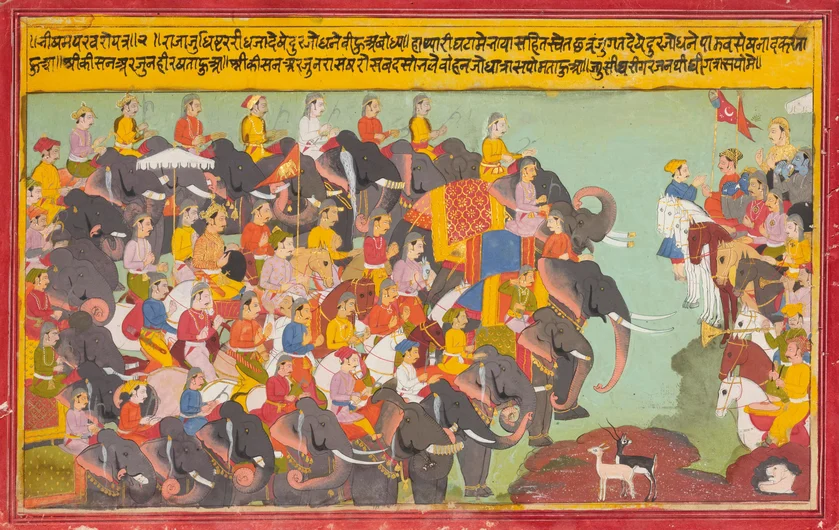
In the very first chapter of the Bhagavad Gita, this sharp contrast between the mentalities of Dhritarashtra and Arjuna can be seen in their respective ways of identifying and categorizing the people who faced each other in the battlefield. In the very first verse, Dhirtarashtra says “What happened between my people (Mamaka)[1] and the others (the Pandavas)?” Clearly Dhirtarashtra’s expression of “my people” did not include the Pandavas, who were not “his people”. On the contrary, as Arjuna confronts the people arrayed before him, he does not see any “other people”, instead all those assembled in the battlefield occur to him as his own people (Drstvemam Svajanam)[2]  – there was no sense of mine and not mine.  

So much conflict, war and violence throughout human history has emerged out of this singular formulation of “Us” and “Not Us”. When one group separates itself away from other groups, and claims to be fundamentally different, whatever be its basis, it seems to inevitably sow the seeds of conflict and confrontation. Colonialism made possible protracted confrontation between the “Civilized Us” against the “Uncivilized Them” in Asia, Africa and the Americas, and inflicted untold violence and misery from which many countries are yet to fully recover. The “Fully Human Us” could buy and sell the “Not Fully Human Them” as slaves and brought about the American Civil war. Islam divides the world into two clear categories, i.e. Muslims and Kafirs, and not just denies the privileges granted naturally to the Muslim “Us” to the Kafir “Them,” but theologically seems to sanction endless confrontation and violence with the Non-Muslim world. Relentless violence may be justified as long as it is being done in the name of Allah and on behalf of Islam. Christianity divides the world into those “Us” who have chosen Christ and adopted the “True religion”, and the “Them” who have not yet chosen Christ and keep clinging on to “False Religions”. This particular formulation gives rise to perpetual violence against non-Christian societies, in the name of “Saving them” and “Sharing the word” and so on. Hitler was able to divide the world into the “Aryan Us” and the “Non-Aryan Them” with devastating consequences for the Jewish people, and Europe as a whole.

So much conflict, war and violence throughout human history has emerged out of this singular formulation of “Us” and “Not Us”. When one group separates itself away from other groups, and claims to be fundamentally different, whatever be its basis, it seems to inevitably sow the seeds of conflict and confrontation. Colonialism made possible protracted confrontation between the “Civilized Us” against the “Uncivilized Them” in Asia, Africa and the Americas, and inflicted untold violence and misery from which many countries are yet to fully recover. The “Fully Human Us” could buy and sell the “Not Fully Human Them” as slaves and brought about the American Civil war. Islam divides the world into two clear categories, i.e. Muslims and Kafirs, and not just denies the privileges granted naturally to the Muslim “Us” to the Kafir “Them,” but theologically seems to sanction endless confrontation and violence with the Non-Muslim world. Relentless violence may be justified as long as it is being done in the name of Allah and on behalf of Islam. Christianity divides the world into those “Us” who have chosen Christ and adopted the “True religion”, and the “Them” who have not yet chosen Christ and keep clinging on to “False Religions”. This particular formulation gives rise to perpetual violence against non-Christian societies, in the name of “Saving them” and “Sharing the word” and so on. Hitler was able to divide the world into the “Aryan Us” and the “Non-Aryan Them” with devastating consequences for the Jewish people, and Europe as a whole.

Furthermore, when one Party in the confrontation, who is bent on dividing the society and draws the “other” Party into the confrontation, the other seems to have very little ability to reason with the first party, even though they may not wish to participate in the “Us versus Them” formulation. There are so many battles going on at so many levels today i.e. Capitalists versus Socialists, White versus Non-White, Aryans versus the Non-Aryans, the Left versus the Right, the Rich versus the Poor, Britain versus the European Union, China versus America, America versus Iran, Russia versus Ukraine, India versus Pakistan, China versus India, the Hindu versus the Anti-Hindu, Israel versus Palestine, Gun owners versus Gun control advocates, Climate change activists versus Climate change deniers, and on and on.

How do we live with “sanity” in our contemporary world? Is it our Pravritti Dharma to take one side or the other in these endless confrontations? Or do we find a quiet corner in the world where we can retreat to and mind our own business, imagining that these confrontations do not apply to our personal lives and move on to Nivritti Dharma? Even as Arjuna sees all as his own people,. one family (Sambandhinah)[3], his choices are stark: Either he runs away from the whole confrontation (takes refuge in Sanyasa living on the food offered freely to Sadhus (Baikshyam)[4], or he has to join the battle for the sake of Dharma, even though he does not have the heart to do so.

If the Kurukshetra war was a civil war that pitted two halves of the same family against each other, the American civil war did the same – it divided a nation. And the current political climate is not any different. We have two halves of a nation each living in its own virtual reality echo-chamber, responding to different facts, and making up different conclusions.

What do people who see this world as one undivided family (e.g. Vasudaiva Kutumbakam) do, when continually assaulted by those who readily divide the world into an “Us versus them” confrontation? If we unilaterally extend an olive branch, an offering of peace, signaling a desire for a truce, what if the other does not reciprocate? What if they simply construe our olive branch as representative of a weakness in our position, and draw us ever deeper into conflict? What will bring forth a transformation in this circumstance? Will a unilateral commitment to Ahimsa from one side of the divide call the other towards a higher consciousness, to embrace the better angels of their nature? How does the seeking of peace transform the other, and move them also into seeking peace and cooperation, rather than war and conflict? Do we speak softly and extend a hand of friendship, while also carrying a big stick, which we make visible at all times? If so, there is only one thing left to do. Procuring a bigger stick, than the other fellow’s, which is what the world is doing. Big Stick diplomacy involves five critical steps, as articulated by the elder Roosevelt: 1) First ensure that you have a big stick; 2) Act justly towards the other – never draw them into a conflict; 3) Never bluff them – Always speak the truth; 4) Strike them only when you are prepared to strike them hard; and lastly 5) Allow the enemy to retreat and save face in defeat.

The Mahabharata also describes the sequence of steps that need to be taken to resolve deep rooted conflicts, exemplified by the terms SarasaSamaDanaBheda and Danda. The first step is Sarasa – always a bi-lateral dialogue, where an attempt is made to reason with the other party, one to one, through which one’s grievances can be expressed and we may seek an appropriate redress directly. We anticipate that in civilized society, as we live in today, a great number of conflicts can be resolved using this primary method not only between individuals and groups but also between nations and alliances among nations. The second step is Sama – which requires an escalation to a mediated dialogue, where a third and neutral party is called upon to arbiter the conversation and serve as a mediator. Again, in modern society, mediation could take place informally, through the intercession of a third party; a counselor, an elder or a qualified mediator, even a court of law. In the realm of conflicts between nations, the United Nations is often called upon to mediate as a neutral entity, in the hope that perhaps a win-win solution can be found, even though its effectiveness may be open to question. The third step is Dana – a voluntary relinquishing of something that one holds to be valuable, in the interest of avoiding further escalation of the conflict. It represents a principle of give and take, a willingness to compromise, to negotiate a settlement of some kind. This may represent a giving up of a certain claim, however difficult it may be, and in the expectation, that the other party involved may recognize and appreciate the sacrifice that has been made, and will avoid further escalation, by in turn giving up some ground themselves. The fourth step is Bheda, which involves a threat of some kind, specifically induced by creating a division, or dissension within the opponent’s camp. In modern parlance, this is applied mostly by the threat of a lawsuit, or propaganda of some kind, which weakens the opponent, and thereby induces them to see the value of avoiding further escalation of the conflict. Among conflicts between nations, threats such as economic sanctions, a boycott of trade, an introduction of a tariff on goods imported, an appeal to the United Nations to impose a ban on another nation, etc., are all examples of the application of the principle of Bheda. The fifth and final step may be Danda – involving an actual act of punishment – where one commits some kind of physical act of violence that is designed to hurt the other, in a manner that would then perhaps have them see the light of day, and avoid further escalation. This step is often an irreversible step and may lead to continued escalation of violence leading to war, especially if the other retaliates with an equal degree of violence. The same rules for escalation can also apply in conflicts of the domestic and social variety, not just international and political.

Escalation into war, de-escalation into a troubled peace, and the maintenance of a tense truce seems to be the way of humanity, from time immemorial. In any case, the procurement of a big stick, the preparation for war at any time, appears to be part of the process of securing a peace by appealing to people’s better angels, even if for a temporary period. Without that stick, that readiness to go to war, talk of peace and Ahimsa appears to be more the prattle of the weak. This is the predicament facing the Hindu people as a whole and has faced them now for over a thousand years. When Hindus talk about Ahimsa, Shanti and Peace, but do not seem to have any stick at all, let alone a big one, they often seem unprepared for conflict, merely engaging in naïve, happy talk. Another striking case in point is the unilateral Buddhist commitment to Ahimsa, concomitant with the total inability to defend their territory in Tibet, with the Dalai Lama being in exile in India. The question is “Where has the Kshatriyata gone?” Or do Hindus even know what that is anymore?

Cover Picture Credit: Artist B. G. Sharma

Source: Internet

[1] Bhagavad Gita, Chapter 1, Verse 1

[2] Bhagavad Gita, Chapter 1, Verses 28-29

[3] Bhagavad Gita, Chapter 1, Verse 34

[4] Bhagavad Gita, Chapter 2, Verse 5

The Hindu Paradigm & World Consciousness

The Hindu Paradigm & World Consciousness

How the Hindu concept of Puruśārtha can help make the world a better place by placing “Pursuit of Happiness” in the right perspective.

The Hindu Paradigm & World Consciousness

“We hold these truths to be self-evident, that all men are created equal, that they are endowed by their Creator with certain unalienable Rights, that among these are Life, Liberty and the pursuit of Happiness.” This quote from the United States Declaration of Independence (DoI) is often pointed to in order to bolster the claim of exceptionalism of the United States and Western culture in general. But what suppositions are implied by this statement, and how can the academic study of Sanatana Dharma function as a counter balance? Specifically, how can the insider voice of the Hindu educated without the historical lens of Orientalism and Indology contribute to the attainment of universal human goals of justice, peace, and respect where the western ideal, as modeled in the Declaration of Independence, has largely failed?

As the colonies finally determined to break from Great Britain due to taxation without representation and the aggressiveness of the British in Boston, they drafted the Declaration as a statement of freedom from the perceived oppression of the king, giving a “powerful voice to the values behind the American Revolution.”1 However, the issue of slavery was omitted, despite evidence that Thomas Jefferson wrote a section to be included condemning the evils of slavery “foisted upon the colonies by the British crown.”2 This omission has cast doubt amongst critics as to the legitimacy of the phrase ‘all men are created equal,’ leaving the question of American exceptionalism up to debate.

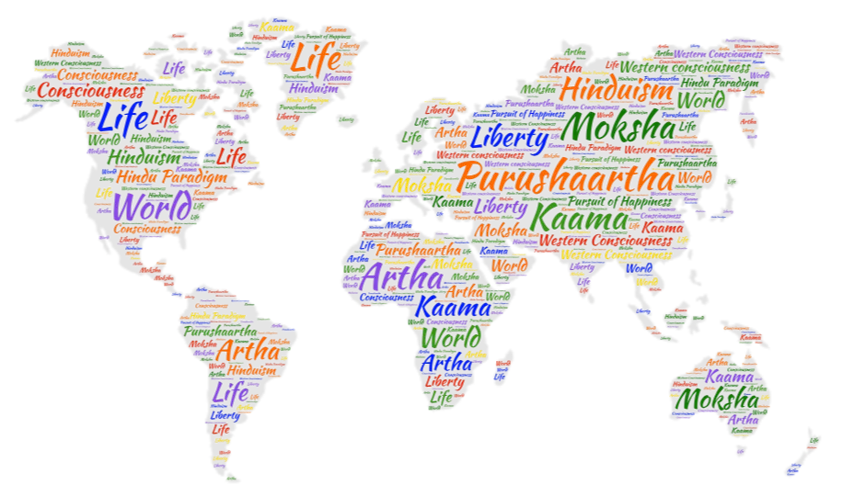
However, when viewed through the Hindu lens of puruśārtha, it is argued that something even more damaging to the long term growth of humanity resides in this document that directly correlates to the current state of the United States, with widespread denial of the pandemic, science, and truth. The concept of puruśārtha within Sanatana Dharma denotes the four main human pursuits and describes “that which is longed for by…purusha, the human being.”3 These include dharma, ethics; artha, securities; kāma, pleasures; and mokṣa, liberation.4 The concept of dharma is subtle within Indian thought and includes ethical behavior towards others at every level, social order, cosmic order, sense of duty, service to the community, self-expression, and as a means for mokṣa.5 This all-encompassing term has particular significance for the argument at hand. Artha refers to all things that bring a person a sense of security and includes things like money, power, social status, property, etc. Kāma is sensual pleasure of many different kinds and its attainment is driven both by instinct and personal value systems.6 In this model, dharma serves to restrain or confine the pursuit of artha and kāma, meaning they are not ends in and of themselves, but are an important part of the human experience when seen in the proper context.

The Declaration of Independence states that the pursuit of happiness in an inalienable right assured to us by none other than God. Yet, what is happiness? No definition is provided. Is it assumed that the answer to the fundamental question of human life is exceedingly apparent to the authors? Lost in time, perhaps, is a contextual answer to this question that could have informed the unabashed pursuit of happiness that resulted. Instead, this seminal idea has led to an extreme sense of individual rights and the pursuit of artha and kāma without the restraining and guiding influence of dharma. This has led to a pervasive lack of concern for the wider community beyond one’s immediate family or like-minded neighbors. We need not look further than the fundamentally selfish and irresponsible response of the US to the pandemic. More important than the welfare of the most vulnerable in our country are the ‘inalienable’ rights to not wear a mask and completely disregard science, while simultaneously hold church services, leading to super spreader events and more death. This seminal idea of the righteousness of near total freedom to pursue undefined happiness for the individual insinuated in the opening lines of the DoI has grown into a massive, ostensibly indestructible weed that threatens to breakdown already tenuous ethical concern for others.

Contrast this with puruśārtha, identifying mokṣa as the main goal of human life. Artha, kāma, and dharma all serve this goal. The pursuit of dharma, security, and pleasure are not condemned, but are seen in a much larger context. This world view is counter to that in the US and can serve to provide meaning and structure to all in a society. These goals are open to all. There is freedom implied, but in a way bounded by dharma with an eye to an ultimate goal shared by all humans. There is compassion implied, not just to humans, but to all beings, to the earth. What would the US look like if its citizens had a semblance of these ideas enshrined in the DoI instead?

Here is a model that the insider, the Hindu or adherent to Santana Dharma can offer the West. But, to do so, there is a need for systematized insider education about the worth and tremendous value of these concepts freed from the lens of Indology. Viewing Sanatana Dharma through the lens of the prevailing academic paradigm completely distorts the reality of these traditions and convinces the insider that the ‘truth’ of the outsider is the only voice. This must be reversed. How?

To this day the only person in human history to bring about prodigious change in a completely nonviolent way is Mahatma Gandhi. The core ideas of satyagraha, holding firmly to Truth, can be applied to developing a new paradigm of Hindu thought. Gandhiji’s technique was to force the English to realize the suffering their rule imposed on Indians by absorbing that suffering and reflecting it back to the British. He and his followers allowed the British to experience their own humanity thus freeing them to see the humanity of the Indian, paving the way to independence.

The modern Hindu, educated by the insider with accurate information about the greatness of Bharat in science, mathematics, psychology, astronomy, literature, etc, and a clear understanding of the value of the spiritual, philosophical, and religious traditions of Sanatana Dharma can practice satyagraha in the face of those representing the prevailing paradigm. Holding firm to the Truth and expounding this to others using multimedia campaigns, development of new education systems, and demonstrating a new emergent consciousness of pride in being Hindu will slowly create a sea change. Eventually, the tipping point will be reached, just like Gandhi ji’s work, but this takes a willingness to sacrifice and hold firm. Asking others to change is a recipe for failure. Others will not change entrenched opinions unless the insider changes and demonstrates the gifts of a higher way of being.

A formal system of Hindu education to build a new paradigm to challenge Orientalism and Indology is vitally necessary to prepare the modern Hindu to bring a worldview based on the ‘technologies’ of Bharat to the world. The West has improved artha for millions of people around by producing helpful medical technologies and other products, but this is not enough. The sole pursuit of artha and kāma will only prolong avidya and suffering. We are seeing that now around the world with constant warfare, increasing selfishness, and the fall of dharma. For the advancement of humankind, the clear voice of the Hindu must be heard.

Bibliography

1 Williams, Yohuru. (2020, Jun 29). Why Thomas Jefferson’s Anti-Slavery Passage was removed from the Declaration of Independence. History.

https://www.history.com/news/declaration-of-independence-deleted-anti-slavery-clause- jefferson#:~:text=What%20isn’t%20widely%20known,cut%20from%20the%20final%20wording.

2 Ibid

3Swami Dayananda. (1989) Introduction to Vedanta. Vision Books. Pg. 1

4Ibid

5Author unknown. (2019). Sanatana Dharma handout. Hindu University of America.

6Swami Dayananda, Introduction to Vedanta,  Vision Books New Delhi, India 1989 pg 3

Cover Image created in Word Art by JS

The Dharma of Global Sustainability

The Dharma of Global Sustainability

Dharma for Global Sustainability aims to deliberate upon the lessons for Global Regeneration from the ancient Vedic Wisdom of Hindu Dharma.

“Everything happens for the best” is one of the foundational axioms of Hindu Dharma that I grew up with. But it is hard to reconcile this axiom with what we know about the cascading environmental catastrophes unfolding on Earth. Fires, floods, hurricanes, droughts are all occurring at increasing frequencies with greater intensities, even as wild animals are dying out at a faster and faster pace every year. The Earth is on fire in the midst of the Sixth Great Mass Extinction event in cosmological history, while nearly a billion humans are food insecure and 20 million people are dying of hunger related causes each year. How can all this “happen for the best”?

The only way this can be construed to have happened for the best is if the environmental destruction has occurred to help Life thrive in the long run. Life is an infinite game. Starting with simple, single-celled organisms that appeared 3.5-3.8 billion years ago, life has been around continuously on Earth until today. Furthermore, it is estimated that the biodiversity on Earth has been increasing almost monotonically, and as of late, even exponentially, starting with the Cambrian explosion some 540 million years ago.

In contrast, we humans have been playing a finite economic game focused on growth. To promote growth, we have

  1. Monetized almost everything so that dead trees and whales have more value than live trees and whales,
  2. Endangered life through climate change and mass extinction,
  3. Addicted almost everyone into compulsive behaviors,
  4. Lied to ourselves systematically about protein, calcium, Santa Claus, Easter Bunny, chemical pollution, product defects, etc.; and
  5. Stolen from the poor in the name of commerce.

This is “Kaurava Economics,” the finite game of the Caterpillar, which cannot grow beyond a certain point on a finite planet. Climate change, biological annihilation, the COVID-19 pandemic and widespread social unrest are all indications that we have reached that point. Besides, why would we want to continue playing a game whose rules were concocted mostly in the middle ages, by colonial traders, to systematically siphon wealth from the global South to the global North, currently estimated to the tune of $3T each year? This is why when we pay $3 for a pound of organic basmati rice in retail stores in the US, only $0.05 reaches the poor village family that grew the rice in Orissa, India. In contrast, when the rich donate $3 for a food aid program, they expect at least $2.70 worth of goods to reach the poor recipient. Surely, if we can keep overhead to 10% when material resources flow down the social pyramid, we can do the same when material resources flow up the social pyramid. However, in the current monetary system, money flows from the top down mainly in the form of loans and it is returned back to the lenders with interest through competitive profit taking in commerce. The intent of this money game is to accumulate wealth. If market competition has been overcome through political corruption and predatory acquisitions by “Too-Big-To-Fail” corporations, then more wealth gets siphoned off during the resource flow. Thus far, the social consequences of such an asymmetrical money game have been mitigated by simply growing the human ecological footprint on Nature. In other words, on the backs of nonhuman animals and ecosystems.

The quest for global sustainability is the quest to transform this finite economic game into an infinite game that is in alignment with Nature. Therefore, the goal of this infinite game should be
to help Life thrive, not to make oneself rich. The quest for global sustainability is akin to the metamorphosis from the Caterpillar to the Butterfly. In line with that analogy, the COVID-19 pandemic has put humanity in the Chrysalis phase, as if Mother Nature has sent us to our rooms to think about what we have done during the Caterpillar phase. Will we emerge from our “time-out” vowing to resume our destructive mischief or will we get serious about realizing our potential to be Butterflies?

Will you join the Kaurava army and will you join the Pandava army in this looming battle of Kurukshetra?

Dr. Sailesh Rao is offering a course on Dharma of Global Sustainability at Hindu university of America. More details about the course can be found here

To learn more about his work, please check the website given in his Author’s profile. 

Mitra! Ask me anything!