









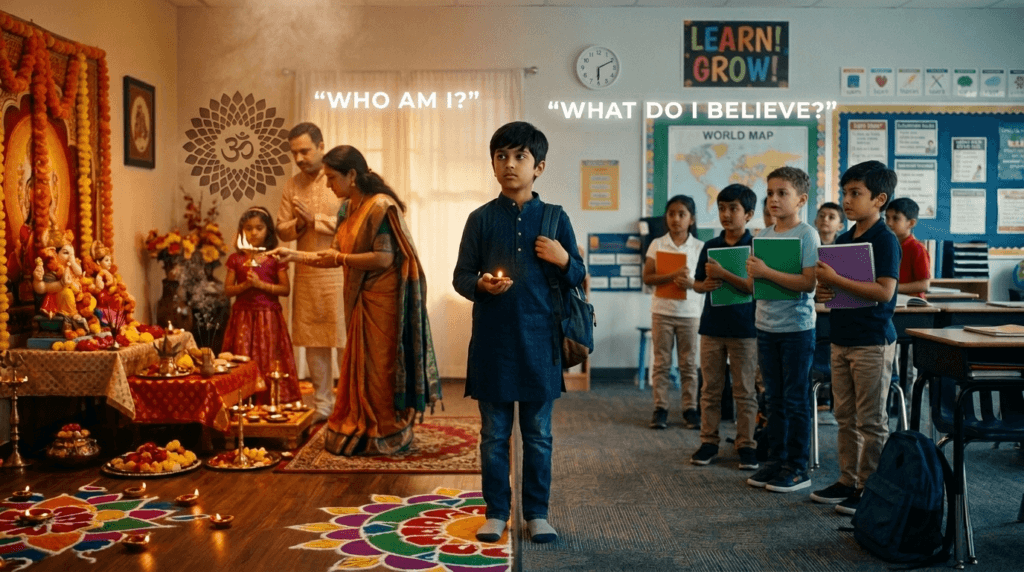
[Photo: A Hindu boy stands between a home puja and a classroom, holding a diya and reflecting on identity and beliefs in modern America]
Raising Hindu Kids in a Polarized America
Reflections from an event organized by Tejas, Detroit.
I gave a talk in the last weekend of January on the topic, “Raising Hindu Kids in a Polarized America”. I had the opportunity to speak with families, especially young parents, on a topic that feels increasingly urgent: What it really means to raise Hindu children in America today. The room was filled with parents who were doing everything they could: celebrating festivals, cooking traditional food, teaching language, passing on the customs; and yet, beneath those efforts, there was a shared unease.
While many parents don’t even sense that something more is needed, those that do, are seeing that what they are doing currently is not working. But they are not sure how to articulate the need, much less what to do about it.
Beyond Culture: Giving Children a Worldview
The first question I was asked by the moderator was, “What should a parent do beyond exposing the child to Hindu culture, festivals, native language, native food, etc.?”
Though these things create civilizationally emotional memories, and emotional memories about one’s civilization are powerful, culture alone does not answer the questions our children are already asking. Our kids are growing up in a world that asks them very early: Who are you? What do you believe? What do you stand for? And this leads them to question themselves and their Hindu practices.
If Hinduism is presented only as something we ‘do’ and not as something that helps explain life, then when those questions arise, our children fall silent. And that silence can be misread. To them, and to others, it can begin to feel as though Hinduism has nothing to say about suffering, responsibility, failure, injustice, or meaning; as though it only consists of rituals and festivals which are undoubtedly beautiful, but offer nothing more.
Raising a Hindu child in America today means helping them understand how Hindus think about life:
- That life has causes and consequences
- That suffering isn’t meaningless; but it also isn’t punishment
- That responsibility matters more than reward
- That truth can be approached in many ways
These ideas don’t need to be taught formally or philosophically. They come up naturally when a child fails, when they lose a friend, when they see unfairness, when they ask why bad things happen. Hindu parenting today isn’t about being more religious. It’s about being more intentional. And being more aware. If we don’t explain our worldview in simple, applicable ways, our children will adopt someone else’s explanations; not because it’s better, but because it’s available.
Another question I was asked was, “Where do Hindu children in the U.S. face the most pressure or confusion?” The answer isn’t always where we expect. Hindu children in the U.S. face pressure in more than one way. Sometimes it’s quiet. But very often, it’s actually quite loud and direct.
Hindu students are openly mocked about having ‘many gods,’ about idol worship, cow reverence, simple rituals and even vegetarian food. There are jokes in classrooms, dismissive comments from peers, and plenty of ridicule on social media. What makes this especially difficult is that it’s often brushed off as humor or curiosity, and not taken seriously as bullying.
Now, interestingly, open attacks don’t usually create confusion. They tend to create resistance or sometimes withdrawal. Attacks establish clear lines. A kid knows, this is hostile when he or she comes across it. What really creates confusion and pressure is something else. It’s the subtle, relational, quiet pressure, the kind that doesn’t feel like pressure at all. That’s where identity slowly shifts because defenses are down. They are like the frog in boiling water.
And most of this doesn’t happen in dramatic confrontations. It happens in everyday spaces. It starts in the classroom, where religion is often discussed using certain frameworks, where belief is expected to look either very personal, very absolute, or very exclusive. Hinduism doesn’t fit neatly into those boxes. So when these topics come up, Hindu students aren’t always sure how to place themselves. Do they explain? Do they simplify? Or do they just stay quiet?
Then there’s pressure from social interactions. Casual conversations, especially in middle school, high school, and college, often revolve around simple questions like, “What do you believe?” or “Are you religious?” Hindu kids don’t always have a one-sentence answer. And when others sound confident and direct, our kids may feel their own tradition is too complex to explain quickly. So they withdraw.
The environment at college campuses adds another layer. Many students come across faith-based groups that are highly organized, very relational, and very confident in their messaging. Even without any overt pressure, that clarity can feel comforting, especially to a young person who hasn’t been given clear language for their own tradition.
There’s also the question of representation: Hinduism is often taught as ancient, cultural, or philosophical but not as something living and present. When children don’t see examples of thoughtful, modern Hindus around them, they may quietly start wondering whether their identity really belongs in today’s world.
This isn’t about hostility alone. It’s really about dissonance. Hindu kids are navigating spaces built around narratives that weren’t designed with them in mind. And when they’re not given tools at home to interpret that experience, confusion fills the gap.
But when children are grounded and when they understand that Hinduism has room for complexity, questioning, and multiple paths, they don’t feel pressured to change who they are. They learn to stand comfortably, even in spaces that don’t mirror their worldview. And that quiet confidence makes all the difference.
At Hindu University of America, this is exactly what we are invested in: helping Hindus move beyond surface-level identity toward a lived, thoughtful understanding of Sanātana Dharma that can sustain the next generation.
From Questions to Solutions: Why Parents Must Learn First
The conversations at Tejas were a reminder that Hindu parenting in America today is not about fear or reaction. It’s about clarity. And clarity, when given early, becomes resilience. The conversation at the event did not end with my 30-minute interview. In many ways, it was only the beginning.
What followed was a full hour of open Q&A with parents, grandparents, and educators in the audience. The questions were thoughtful, honest, and deeply personal. They weren’t abstract or ideological. They came from lived anxiety:
- What do we actually do when our child is confused?
- How do we answer questions without oversimplifying or sounding unsure ourselves?
- How do we prepare our children for school, college, and the workplace without making them defensive or reactive?
And almost every question circled back to one quiet realization: our children’s confidence depends upon our own clarity.
One theme became unmistakably clear during the Q&A. Most parents were not struggling because they didn’t care enough or did enough culturally. They were struggling because they lacked the language, the vocabulary to explain Hindu thought in simple, contemporary terms.
Parents often told me: “I know what I believe but I don’t know how to explain it.”
And that gap matters.
Children today are not just absorbing beliefs at home. They are constantly asked to articulate themselves in classrooms, on campuses, in peer groups, and eventually in professional spaces. Silence or vagueness doesn’t remain neutral in those environments; it is often interpreted as uncertainty.
This is why I emphasized during the session that the work must begin with parents and grandparents. Before we can equip our children, we must equip ourselves, Not with slogans nor with defensive arguments, but with a grounded understanding of Hindu worldviews: how dharma, karma, pluralism, responsibility, and inquiry actually function as ways of thinking about life.
When the question of solutions came up, it gave me the space to speak about something essential: intentional adult education.
If we want children to speak confidently about who they are, adults must first be able to think clearly about what Hinduism offers as a living framework and not as nostalgia of a forgone past.
This is where Hindu University of America becomes not just relevant, but indispensable.
HUA’s courses are not designed only for scholars or academics. They are for parents, professionals, grandparents, people who want to understand Hindu traditions deeply enough to explain them calmly and coherently in today’s world. The goal is not religious instruction in a narrow sense, but intellectual grounding.
When adults gain that grounding, something powerful happens:
- Conversations at home become more natural
- Children hear clear language modeled regularly
- Complex ideas are not avoided but normalized
- Confidence grows quietly without confrontation
And when children carry that confidence into schools, colleges, and workplaces, they don’t feel the need to over-explain or under-represent themselves. They can articulate their beliefs without anxiety because those beliefs have been articulated to them first.
A Generational Responsibility
One of the most moving aspects of the event was hearing grandparents speak in offstage conversations. Many of them recognized that the America their grandchildren are growing up in is very different from the one they once navigated. Culture alone no longer bridges that gap.
What does bridge it is education that travels across generations.
HUA offers that bridge: between tradition and modernity, between scholarship and lived life, between inheritance and articulation. When parents and grandparents invest in their own understanding, they are not just learning for themselves. They are creating a vocabulary that will carry forward.
The Tejas event reminded me that Hindu parenting today is not about shielding children from the world. It is about preparing them to stand in it calmly, confidently, and without confusion and that preparation begins with us.
Let me say this simply:
HUA exists because Hindu knowledge didn’t disappear. It was displaced, especially in the humanities and liberal arts. It wasn’t erased for it is now evident in satsangs, community gatherings, in mandirs, and even in homes.
But it wasn’t preserved in institutions. And if we don’t take responsibility for restoring it in serious academic spaces, someone else will continue explaining it to us.
Most people don’t come to HUA because they want a credential. They come because something feels unfinished. They’ve lived full lives, built careers, raised families and yet there’s a gap between what they practice at home and what the world recognizes as “knowledge.”
Although Hindu University of America formally operates within the framework of American higher education—adhering to the standards, structures, and regulations that govern accredited institutions—it serves a purpose that extends far beyond the conventional definition of a university.
HUA functions as a rare and much-needed civilizational space: one where inherited silences are given language, historical dislocations are examined with honesty, and long-standing civilizational wounds are acknowledged, studied, and thoughtfully healed. It is not merely a place where information is transmitted, but where understanding is restored, where generations shaped by colonial narratives, displacement, and misrepresentation are finally able to encounter their own traditions with intellectual dignity and clarity.
In this sense, HUA is not only educating individuals; it is quietly nurturing the future of Sanātana Dharma itself. By grounding Hindu thought in rigorous scholarship while keeping it accessible to contemporary seekers, parents, and professionals, the university enables dharma to be carried forward with confidence and insight rather than defensiveness.
So when we work for HUA, whether in fundraising, academics, or outreach, we’re not just supporting a university. We’re doing something our community was never trained to do: institutionalize dharma for future generations. That’s why HUA matters. And that’s why this work is bigger than any one role, event, or fiscal year.
I have been asked this question repeatedly: “I have been watching YouTube videos for several years on Hinduism. I even listen to lectures of my favorite Sant and dharma guru. Why should I take courses at HUA?”
That’s a fair question and honestly, it’s a good sign that they are already learning on their own. YouTube is wonderful for exposure. It introduces ideas, stories, and perspectives. But it’s fragmented by design. You’re getting pieces, often out of sequence, without context, without continuity, and without a way to test or deepen what you’re learning. A course at HUA does something different.
It gives the seeker structure. They are not just consuming content. They’re moving through a carefully designed arc of learning, where texts, ideas, and traditions are placed in conversation with each other.
It offers the student depth. Instead of summaries or opinions, the student is able to engage with primary sources, scholarly frameworks, and instructors who’ve spent decades with these traditions.
It gives to the learner language. Many people feel Hinduism deeply but struggle to explain it: to their children, to colleagues, or even to themselves. HUA helps them clearly and confidently articulate what they already intuitively know.
And it gives the student legitimacy. In a world where Hindu knowledge is often filtered or misrepresented in academic spaces, HUA ensures that what they’re learning is not just inspirational, but also rigorous, grounded, and recognized.
So YouTube can spark curiosity. HUA helps integrate it intellectually, coherently, and confidently.
Most of our students come to HUA after years of independent learning. They come because they’re ready to move from exploration to understanding.
Conclusion
In the end, raising Hindu children in America is not a project with quick fixes or ready-made answers. It is a long civilizational task; one that asks each generation to decide whether Hindu thought will remain private, intuitive, and unnamed, or whether it will be understood, articulated, and carried forward with confidence. Institutions like Hindu University of America exist precisely because this choice can no longer be postponed. When adults choose to learn seriously, to name what they live, and to stand behind it with clarity, children inherit more than culture; they inherit coherence. And that inheritance quietly shapes how they walk into classrooms, campuses, workplaces, and the wider world; not searching for who they are, but already knowing where they stand.