SAN3012 – Laghu-Siddhānta-Kaumudī – Beginner 2 introduces students to the principles and applications of sandhi (of which vowel sandhi was covered in the previous course) as presented in the Laghu Siddhānta Kaumudī, using the edition and translation by Medha Michika. Specifically, consonantal sandhi, visarga transformations, and anusvāra-related changes, with systematic reference to Pāṇinian sūtras are covered here. By the end of the course, students will be able to recognize, analyze, and accurately interpret non-vowel sandhi in Sanskrit prose and verse, including passages from Sanskrit texts and various stotras, thereby preparing them for deeper study of Pāṇinian grammar in subsequent courses.
Completion of Laghu Siddhanta Kaumudi – Beginner 1
Semester / Quarter System:
Quarter
Number of Weeks:
11
Semester / Quarter Offered:
Spring 2026
Days of the Week:
Every Sunday
Time:
4:00 pm EST – 6:00 pm EST
Start Date:
End Date:
Faculty
Shri Haridas Radhakrishnan
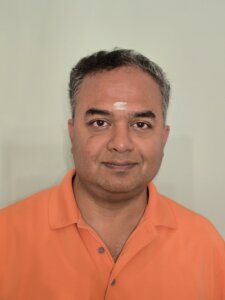
Shri. Haridas Radhakrishnan, Sanskrit faculty at HUA’s Community Education Division, holds an MA in Sanskrit from HUA/MITSVS Pune, bringing deep understanding and joyful passion for Saṃskṛtam to his teaching.
Smt. Parvathi Sriram serves as the Coordinator of Sanskrit Studies at HUA. A physical therapist by profession, she has over a decade of experience in teaching Samskritam and vedanta.
Shri. Haridas Radhakrishnan, Sanskrit faculty at HUA’s Community Education Division, holds an MA in Sanskrit from HUA/MITSVS Pune, bringing deep understanding and joyful passion for Saṃskṛtam to his teaching.
Smt. Parvathi Sriram serves as the Coordinator of Sanskrit Studies at HUA. A physical therapist by profession, she has over a decade of experience in teaching Samskritam and vedanta.
By the end of the course, students will be able to:
Identify and apply non-vowel sandhi rules accurately
Analyze sandhi formations using relevant Pāṇinian sūtras
Read Sanskrit text with phonetic correctness
Distinguish obligatory and optional sandhi applications
Featured Testimonial
Course Content
The course begins with a detailed study of hal-sandhi, or consonant sandhi, as expounded in the Laghu Siddhānta Kaumudī. This section explores how adjacent consonants interact at word and morpheme boundaries, leading to voicing, substitution, assimilation, or elision. Special attention is given to the behavior of stops, sibilants, semivowels, and nasals, and to the phonetic rationale underlying these changes, as explained through key Pāṇinian rules.
The syllabus then proceeds to nasal and anusvāra sandhi, addressing the conditions under which final nasals are replaced by anusvāra and the principles governing homorganic nasal substitution (parasavarṇa). Both obligatory and optional forms are studied, with illustrative examples drawn from classical Sanskrit usage, enabling students to recognize acceptable variants and apply the rules correctly in practice.
Finally, the course covers visarga sandhi, examining the origin and phonetic nature of the visarga and its transformations in different phonological environments. Students study the substitution of visarga by s, r, ś, or ṣ, as well as cases of retention or elision, depending on the following sound. The application of major Pāṇinian sūtras governing visarga changes is emphasized, along with their relevance to accurate recitation and textual interpretation.
Class Structure
2 hours of class per week, 10 weeks per quarter, with Homework assignments as decided by the faculty, and a Quarter End Examination.