Hindu University of America Logo

Hindu University of America

Menu

BECOME A FRIEND
Give to HUA
Login to LMS
Hindu University of America Logo

Hindu University of America

Menu

FAQ

BECOME A FRIEND
Give to HUA
Login to LMS
BECOME A FRIEND
Give to HUA
Login to LMS

Menu

  • About HUA
    • About HUA
    • President’s Message
    • Goals & Objectives
    • Learning Outcomes
    • Mission & Vision
    • Values
    • Ethos And Culture
    • Our Promise
    • Team
    • Partners
    • Heritage
  • Academics
    • Academics
    • Divisions
    • Programs
    • Areas of Study
    • Courses
    • Faculty
    • Credit Hours
    • Academic Calendar
  • Ayurveda College
  • Admissions
    • Admissions
    • Contact
    • Apply
    • Conversion Formula
    • Credit Transfer
    • Tuition and Fees
    • Scholarships
  • Advancement
    • Advancement
    • Director’s Message
    • Giving to HUA
    • Giving Categories
    • Sustenance Funds
    • Capital Funds
    • Endowment Funds
    • Donor Recognition
    • Legacy Gift Guidelines
  • Activities
    • Videos
    • Webinars
    • Events
    • Photos
  • Blog
  • Login
    • Calendar
    • Drive
    • Chat
    • Meet
Latest Blog Raising Hindu Children in a Polarized America
Annual Giving Campaign - 2025-2026 is under way. Donate today by Clicking Here, and help us reach our goal.
So far $1,248,668 has been raised out of a target of $ 3 Million. Click Here to donate today and help us reach our goal.
Close button icon for closing popups
Hindu University of America Logo

Hindu University of America

  • About HUA
          • About HUA
          • President’s Message
          • Goals & Objectives
          • Learning Outcomes
          • Mission & Vision
          • Values
          • Ethos And Culture
          • Our Promise
          • Team
          • Partners
          • Heritage
        • Man in white doing yoga pose at ancient stone temple ruins
        • Learn more about HUA

        • Legacy Gift
        • Donate Today

  • Academics
          • Academics
          • Divisions
          • Programs
          • Areas of Study
          • Courses
          • Faculty-old
          • Credit Hours
          • Academic Calendar
        • Indian students using laptop with Academics page on screen
        • Explore programs and courses

        • A group of 5 young adults sitting with laptops & phones in campus setting
        • Browse our course catalog

  • Ayurveda
  • Admissions
          • Admissions
          • Contact
          • Apply
          • Conversion Formula
          • Credit Transfer
          • Tuition and Fees
          • Scholarships
        • Students
        • Learn more about our admissions process

        • Legacy Gift
        • Apply Now

  • Advancement
          • Advancement
          • Director’s Message
          • Giving to HUA
          • Giving Categories
          • Sustenance Funds
          • Capital Funds
          • Endowment Funds
          • Donor Recognition
          • Legacy Gift Guidelines
        • View of planet Earth from space showing Indian subcontinent
        • Learn about giving to HUA

        • Night view of Ganga river with illuminated ghats and buildings
        • Give to HUA

  • Activities
          • Videos
          • Webinars
          • Events
          • Photos
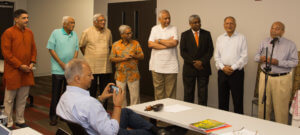
        • A group of men standing in a room during HUA gathering or event
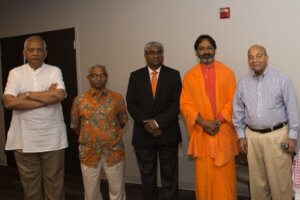
        • Five men standing together at HUA event, including a swami in orange robes
  • Blog
  • Login
          • Calendar
          • Drive
          • Chat
          • Meet
        • A group of 5 young adults sitting with laptops & phones in campus setting
        • Access HUA Email

        • Indian students using laptop with Academics page on screen
        • Access HUA LMS

Course Details

Home / Featured / The Three Vedantic Perspectives of Ishavasya Upanishad

The Three Vedantic Perspectives of Ishavasya Upanishad

$300.00

Register for Course

Course Code:

TAT4003

Credit Hours:

1.5 Quarter-Credit-Hours

Course Level:

400

Area of Study:

Texts and Traditions

Course Description

TAT4003 – An overview of three commentaries on the IsA-vAsya Upanishad is the main topic of this course. IsA-vAsya Upanishad is traditionally listed as the first among the well-known ten Upanishads, namely, 1) Isa 2) Kena 3) Kata 4) Prasna 5) Mundaka 6) Mandukya 7) Taittiriya 8) Aitareya 9) Chandogya 10) Brihadaranyaka. This Upanishad contains the main tenets of all the major useful to understand the philosophy of Vedanta. This course focuses on the summary of the views of Shankaracharya, Vedanta Desika and Madhvacharya on the IsA-vAsya-Upanishad. These three commentaries represent three Vedantic schools are known as mata-traya or the 3 major schools namely Advaita, Visistadvaita and Dvaita respectively. These three views are comprehensive and definitive in terms of concepts of Vedanta in general.
Apply for Program
Enroll In Program
Scholarships
Ask Us A Question
Express Interest

Program of Study

This course is part of the following programs:

  • Community Education Program (CEP)
  • Community Education Program (CEP)

Division

Community Education Division

Required / Core / Elective:

Elective

Prerequisites:

Admission into a Program of Study

Semester / Quarter System:

Quarter

Number of Weeks:

11

Semester / Quarter Offered:

Winter 2024

Days of the Week:

Every Sunday

Time:

11:00 am EST – 12:30 pm EST

Start Date:

January 14, 2024

End Date:

March 24, 2024

Faculty

Mr. Krishna Kashyap

Sri Krishna Kashyap is an engineer and businessman by profession. He holds a Master’s Degree in Engineering from University of Iowa, USA. Currently he is retired and lives in India after working in the USA for about 39 years in various areas of technology and business for several companies. Krishna Kashyap has devoted significant time on the study of Vedanta, Sanskrit and Yoga studies and practice for several decades, from many traditional teachers
read more

krishna.kashyap@hua.edu

Course Learning Objectives:

In this course students will be able to:

  • Understand the basic message of this Upanishad and the structure of it based on three schools.
  • Explore deeper views, paradigms and concepts pertaining to this Upanishad.
  • Understand the portions of the Upanishads where there is no disagreement between these schools.
  • Identify the key verses of the Upanishads that are understood differently by these commentators.
  • Understand how these different views can be reconciled.

Featured Testimonial

Course Content

The word “Vedanta” means “end of the Vedas”, and encompasses the ideas and philosophies present here, with a focus on knowledge and liberation. Vedanta developed into many sub-traditions, all of which base their ideas on the authority of a common group of texts called the Prasthānatrayī , translated as “the three sources”: the Upanishads, the Brahma Sutras and the Bhagavad Gita. All Vedanta traditions contain extensive discussion on ontology, soteriology and epistemology.

IsA-vAsya Upanisad, according to tradition, contains the important tenets of Vedanta and gives a methodic guide for a deep study of the Upanishads, in general. A superficial analysis of these three different commentaries on IsA-vAsya Upanishad, gives the reader the impression that they are too divergent. However, a deeper analysis will be presented in this course that can illumine the underlying harmony between these views.

Any student interested in a deep study of this Upanishad will benefit immensely from this course. Basic level knowledge of Sanskrit will be useful but not necessary to understand the Upanishad. Any reference to Sanskrit verses will be explained in English. There are no other prerequisites for this course.

Further, in this course, a reconciliation between these views will be attempted based on works by well-known scholars. Rarely scholars venture into such a reconciliation.

Class Structure

There will be a minimum of 1 contact hour with one or more faculty every week. The class is structured in a way that promotes discussion and debate based on self-study and reflection each week. While the content being discussed in each class will be concluded within 60 minutes, the discussion time will be free format and can continue for an additional 30 minutes maximum.

During the course, students will be required to submit a paper of 1000 to 1500 words. They need not be academic quality papers – but should be based on students’ self-reflection on what they have learned and assimilated so far.

X

The Three Vedantic Perspectives of Ishavasya Upanishad

$300.00

Clear

Share:

Browse course catalog
Hindu University of America | HUA

Be Part of The HUA Community

Sign-up for HUA communications

Hindu University of America

Main Campus:

  • Pine Lake Retreat Center,
  • 21725 FL-33,
  • Groveland, FL 34736

Administrative Office:

  • 5200 Vineland Rd #125
    Orlando, FL 32811
  • 407 545 5057
  • 407-205-2118
  • info@hua.edu
  • Tax ID / EIN: 59-2977691
Links
  • About HUA
  • President’s Message
  • Goals & Objectives
  • Learning Outcomes
  • Mission & Vision
  • Values
  • Ethos And Culture
  • Our Promise
  • Team
  • Partners
  • Heritage
  • About HUA
  • President’s Message
  • Goals & Objectives
  • Learning Outcomes
  • Mission & Vision
  • Values
  • Ethos And Culture
  • Our Promise
  • Team
  • Partners
  • Heritage
Social
  • Facebook
  • Twitter
  • Instagram
  • Youtube
  • LinkedIn

Be Part of The HUA Community

Sign-up for our free webinars

HUA Mitra

AI Mitra
Namaste! How can I assist you today?
Mitra! Ask me anything!
1
Cart
  • Your cart is empty! Return to shop
Checkout - $0.00
  • 0
  • 1
Community Education Program
Please click on the link below to enroll into the The Three Vedantic Perspectives of Ishavasya Upanishad Program or the appropriate phase.

On the program page, there are multiple payment plan options to choose from.

Community Education Program

The Three Vedantic Perspectives of Ishavasya Upanishad

Animated loading spinner icon in orange on white background

Courses in the Program

  • SAN5101 Vedic Sciences Foundations
  • SAN5102 Vyakarana 01
  • SAN5103 Sahitya I – Landscape
  • SAN5104 Veda I – Introduction to Vedas
  • SAN6101 Nyaya Vaisesika Basic
  • SAN6102 Vyakarana II
  • SAN6103 Sahitya II – Padya
  • SAN6104 Vedas II – Rgveda
  • SAN6105 Yoga Basic
  • SAN7101 Nyaya Vaiseshika Advanced
  • SAN7102 Vyakarana III
  • SAN7103 Sahitya III – Nataka
  • SAN7104 Veda III – Yajurveda-Samaveda
  • SAN7105 Ayurveda Basic
  • SAN7106 Mimasa Basic
  • SAN7107 Jyotisha Basic
  • SAN8101 Term Project
  • SAN8102 Vyakarana IV
  • SAN8103 Sahithya IV – Gadya and Campu
  • SAN8104 Veda IV – Atharva Veda
  • SAN8105 Yoga Advanced
  • SAN8106 Mimasa Advanced
  • SAN8107 Jyotisha Advanced
  • SAN8108 Ayurveda Advanced
  • SAN8109 Vedanta Basic
  • SAN8110 Vedanta Advanced
Animated loading spinner icon in orange on white background